When children are to be removed from their homes to ensure their immediate safety, grandparents, abuelas, aunts and uncles, cousins, and close family friends may step forward to care for the child.
Learn more about informal kinship here.
When children are to be removed from their homes to ensure their immediate safety, grandparents, abuelas, aunts and uncles, cousins, and close family friends may step forward to care for the child.
Learn more about informal kinship here.
Families are often supported by multiple systems and it’s crucial to collaboratively these factors across multiple sectors of society, not just in silos, to effectively strengthen families.
Learn more about the Texas Prevention Ecosystem
This month marks 11 years into a federal lawsuit against the state of Texas, where the state’s foster care system has shown repeatedly that they are engaging in practices that place the children in its care at an unreasonable risk of harm.

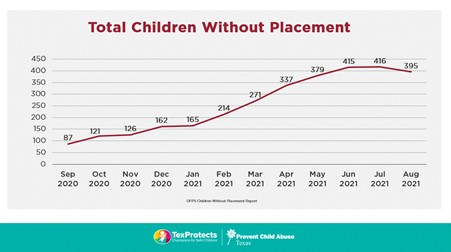
During the past year, the number of children without placement, often referred to as CWOP, has been a significant focus of the lawsuit proceedings due to the 378% increase of children that were sleeping in CPS offices or other unregulated settings. While placement shortage is often cited as the cause for CWOP, there are deeper root causes such as inadequate behavioral and medical health supports for children, which was a highlighted recommendation of the expert panels’ presentation of many short and long-term strategies to Judge Jack in January. The state was given 90 days to plan actions for better mental health access for children in CPS custody and the deadline is quickly approaching.

The Department of Family and Protective Services and the Health and Human Services Commission (responsible for monitoring and regulation of facilities) have since responded with their progress and plan. They have mostly agreed to pursue the 23 expert panels’ recommendations that are intended to foster better coordination and accountability between DFPS and HHSC; expand access to and resources for children, families, and family-like settings; and improve practice to align with the guiding principles and practice model. As we approach the next legislative session, TexProtects has proposed many of these recommendations and promoted strategies that align including:
DFPS and HHSC agreed to pursue the following:
DFPS and HHSC only raised issues with the implementation and the timeline on a few of the expert panel’s recommendations:
You can become a foster parent in Texas! We put together the 6 ways you can become a foster parent and answered your most frequently asked questions. View them here.
Earlier in the month, Judge Janis Jack conducted a hearing to follow up on the progress made on the thirteen remedial orders. The Department of Family and Protective Services (DFPS) and Health and Human Services Commission (HHSC) were not in compliance and were previously held in contempt.
Ahead of the hearing, the court-appointed Special Monitors filed two reports, one of which detailed the information they compiled regarding updates on these remedial orders and the other that went into more depth about the placement capacity crisis, which has left children without placement and being housed in unlicensed facilities.
Ultimately, the reports indicated substantial progress in some areas, including:
While there have been improvements, some startling information reveals that the state continues to place children at an unreasonable risk of harm. Also, concerns were raised about the safety and lack of placements. In fact, 23 children in the Permanent Managing Conservatorship of the state have died since the Fifth Circuit issued its final ruling in July 2019. The reports and two-day-long hearing continued to point out that licensed placements continue to operate despite their long histories of deficiencies. Judge Jack repeated numerous times her concerns with placements being able to close their facilities and open up a new placement under a different name to avoid enforcement measures. Information was also revealed about children being housed in unlicensed facilities when a placement can’t be secured. Furthermore, 339 children have slept at least one night in a DFPS office since August 2020.
Interestingly, this was the first hearing in which the Single Source Continuum Contractors (SSCCs) in areas in which Community-Based Care (CBC) has been implemented were present and questioned alongside DFPS. Judge Jack made it very clear that the SSCCs were also under the same orders as DFPS. However, the information provided by the Special Monitors revealed that DFPS outperformed the SSCCs in several areas. They also raised questions about the implementation of CBC and the ability of DFPS to provide proper oversight, including concerns with:
Throughout the hearing, the resounding question from Judge Jack was “when?” in reference to what the plan is to come into compliance with each remedial order. While the hearing ended with Judge Jack expressing some optimism for the state agencies and SSCCs, there is no doubt that some major issues need to be addressed. We are approaching two years since the remedial orders have been mandated. We all share with Judge Jack’s standing questions of “when.” The stakes are high. For the sake of children’s wellbeing and lives, there is no time to waste.

The best way to get policymakers to make the changes we need to protect children and families is to provide them with evidence that proves investing in prevention works. Not only will our state finances see the benefits but so will Texas children at risk of abuse and neglect. Jennifer Lucy, our Managing Director of Policy, submitted the public testimony below to the House Appropriations and Senate Finance Committees proving that investing upstream works; it saves dollars and makes sense!
By Jennifer Lucy, Managing Director of Policy for TexProtects, on Article II budget for FY 2022-2023.
TexProtects is the only statewide organization singularly focused on the prevention of child abuse and neglect, and we serve as the Texas Chapter for Prevent Child Abuse America and as a steering committee member for the Texas Child Protection Roundtable and Prenatal to Three Collaborative. We applaud the maintenance of prevention funding in the base budget and appreciate the work of this committee in ensuring that the health and well-being of the next generation remain primary in our approach to COVID-19 response and recovery.
Texas has an opportunity to use what we learned during COVID-19 to transform systems in ways that support families, rather than removing children, and roll out proven prevention strategies BEFORE a crisis. Like any smart investor, it’s critical that we pay for the outcomes we do want rather than those we don’t. This requires a shift upstream and will result in downstream cost savings across multiple systems for decades to come as today’s children grow up to be the strong Texas of tomorrow.
The cost of the status quo and inaction is clear. Adverse Childhood Experiences (ACEs) like child abuse and neglect are associated with negative outcomes for individuals across the lifespan including poorer health, lower educational attainment, and higher likelihood of experiencing unemployment. Individuals and governments incur significant costs as a result. Bellis et al. (2019) estimate that annual costs attributable to ACEs across North America are approximately $748 billion with 82% of the costs resulting from individuals who had two or more ACEs.[i] With one in 10 American children living in Texas, we can expect to incur a significant percent of those costs if we are not better able to prevent ACEs.
Healthcare costs are the most well-documented, but there are also criminal justice, child welfare, and education costs, among others. Each case of child abuse or neglect results in $830,000 in costs across the victim’s lifetime.[ii] This translates to over $55 billion in costs as a result of confirmed abuse and neglect in Texas in 2019 alone. We can continue to pay for the effects of childhood adversity, or we can work to prevent it.
TexProtects worked with Child Trends to look specifically at the potential impact of COVID-19 on child abuse and neglect risks and found reason to believe that increases in unemployment, mental health struggles, family violence, substance use issues, and parental stress may result in increased abuse and neglect. Research during the last recession found that for each point the unemployment rate rises, physical and emotional abuse increase by 12-15%.[iii]
However, with the large majority of Child Protective Services (CPS) cases addressing neglect rather than abuse and much abuse/neglect going unreported, we know families need support more often than they need protection. The most cost-efficient and effective approaches offer supports BEFORE A CRISIS occurs and during the first years of life when a stable, safe, nurturing caregiver is THE KEY to healthy child development.
The 87th legislature can increase access to proven support strategies that protect children by implementing the following recommendations in the 2022/2023 budget for Texas.
Proven prevention programs administered through the Prevention and Early Intervention (PEI) division at the Department of Family Protective Services (DFPS) have been critical lifelines for families during COVID-19 and depend on an infrastructure of community providers who work together to support families. Over the past decade, state and federal investments have helped build community-driven prevention infrastructure that accelerates the work of local nonprofits to deliver parenting support, information on local resources, and health screenings to children and their families. These voluntary programs have a proven return on investment of between $1.26 and $8.08 and have impacts across multiple domains and two generations. [iv]
Only 4% of the families in highest need currently have access, therefore, expansion is critical if Texas desires the statewide impact and cost savings that could result from widespread access to these programs. The current PEI strategic plan indicates that to adequately protect families, a 20% increase in prevention funds is needed every biennium. Currently, DFPS only spends 5% on early prevention efforts compared to CPS costs.
Texas must be proactive and innovative in determining how to maximize the opportunity of the Family First Prevention Services Act (FFPSA) to access federal matching funds for prevention funding that can be used to directly address the key drivers of child abuse/neglect: substance use, mental health, and parenting skills. With the large majority of CPS cases addressing neglect rather than abuse, we know families need support more often than they need protection. As noted by the DFPS 2018 Prevention Task Force Report, “Preventing 3% of removals (593) would save upwards of $20.3 million.”
Use of these funds should be prioritized for evidence-based programs that will prevent entry into the foster care system as this is the primary way to ensure better outcomes for children, family preservation, and long-term cost savings for the state.
The current plan provided by the agency proposes that $33.9 million of the $50.4 federal transition funds go toward prevention. All prevention strategies recommended here rely on community contracts rather than staff who work for DFPS.
Option 2D (A pilot for prevention services carried out by DFPS’ PEI division): PEI offers services to families to prevent child abuse and neglect. Their efforts focus mainly on primary prevention, which aims to reach families before the first occurrence of child maltreatment. However, some of their programs also focus on secondary prevention, which targets families who are at high risk of child maltreatment, such as families participating in Family-Based Safety Services (FBSS). Grants would be awarded to up to six regions. One community contractor would receive the grant in each region and then decide which programs to fund and deliver either through their own services or those of local subcontractors.
Option 2E (Expand HIP [Helping through Intervention and Prevention] for all pregnant and parenting foster youth):HIP is an effective program through PEI that serves current and former foster youth who are pregnant or parenting a child under the age of 3 by providing in-home parent education services. Additional funds would allow expansion of these voluntary support services.
These options focus on strategies that are evidence-based and have shown that they can keep children safe and reduce child maltreatment. They also already have an established and successful infrastructure. Some of the programs also have experience serving families participating in FBSS, who fit the eligibility definition and have already been approved by the Clearinghouse, including Healthy Families America, Nurse-Family Partnership, and Parents as Teachers.
The other options presented by DFPS would require a great length of time before they could be implemented (i.e. carrying out prevention services through Community-Based Care) or would be relying on FBSS caseworkers to deliver programming that is outside their area of expertise and/or credentialing requirements. Both would require significant deviation for systems and staff and potential conflicts of interest or complexities that do not make it feasible.
In 2009, the Texas Legislature passed Senate Bill 2080 to establish the MedCARES grant program as part of a strategic response to growing numbers of child abuse and neglect-related fatalities. The bill was championed by Senator Jane Nelson with the help of now Lieutenant Governor Dan Patrick; Representatives Garnet Coleman, Tan Parker, Toni Rose, Rafael Anchia, and Abel Herrero; and now Senator Jose Menéndez.
MedCARES provides grant funding to hospitals, academic health centers, and facilities with expertise in pediatric health to prevent, assess, diagnose, and treat child abuse and neglect. MedCARES grant recipients give communities easy access to medical providers who support education for the general public, case reviews for other physicians, trainings, and expert courtroom testimony by child abuse specialists. MedCARES providers include general pediatricians, child abuse pediatricians (CAPs), nurse practitioners, social workers, and sexual assault nurse examiners.
COVID-19 has exacerbated child abuse risks due to increased family stress, increased substance use, and heightened economic insecurity. Cutting MedCARES compromises critical infrastructure we have in place to protect children in Texas. Last year alone, almost 22,000 professionals attended child abuse prevention trainings through MedCARES and more than 2 million individuals participated in prevention program activities.
Thank you for your attention to these critical investments that not only support families and protect children today–but ensure a brighter Texas tomorrow.
We look forward to working with you. Please contact us anytime if we can provide support or resources as you address these and other child protection issues.
Jennifer Lucy
Managing Director of Policy
512-971-9347
Members of our Advisory Board include:
The Hon. Darlene Byrne, J.D. | Rebel Calhoun | Leslie Carpenter | John Castle, Jr., J.D. | Leslie DeCillis Debra Decker | The Hon. Maurine Dickey | Catherine Estrada | Robert Estrada | Kathleen Fletcher, Ph.D. Laura Gardiner | Tammy Cotton Hartnett | The Hon. Lee Jackson | Scott Murray | Len Musgrove
Janet Pozmantier, MS, LPC | Dick Rogoff | The Hon. Peter Sakai, J.D. | The Hon. Florence Shapiro
Lisa K. Simmons | The Hon. Mark Strama | The Hon. Royce West, J.D.
About TexProtects
TexProtects’ mission is to protect Texas children from the trauma of abuse and neglect and empowers families to thrive through education, research, and advocacy. Our vision is that all children are safe, nurtured, and resilient. To achieve our mission, TexProtects engages in research, advocacy and education. We advocate for better policies, reforms and appropriate increases in federal, state and local funding for three priority areas: 1) Prevention: Increasing investment in proven child abuse prevention programs, 2) Protection: Strengthening and reforming the CPS system, and 3) Healing: Ensuring victims receive adequate and accessible treatment.
[i] Bellis et al (2019)
[ii] Peterson et al (2018)
[iii] Schneider, W., Waldfogel, J., & Brooks-Gunn, J. (2017).
[iv] : Prinz, R. J., Sanders, M. R., Shapiro, C. J., Whitaker, D. J., & Lutzker, J. R. (2009); Chaffin, M., Hecht, D., Bard, D., Silovsky, J. F., & Beasley, W. H. (2012). DuMont, K., Mitchell-Herzfeld, S., Greene, R., Lee, E., Lowenfels, A., Rodriguez, M., & Dorabawila, V. (2008); Olds, D. L., Kitzman, H. J., Cole, R. E., Hanks, C. A., Arcoleo, K. J., Anson, E. A., . . . Stevenson, A. J. (2010); Olds, D. L., Kitzman, H., Hanks, C., Cole, R., Anson, E., Sidora-Arcoleo, K., et al. (2007); Olds, D. L., Robinson, J., Pettitt, L. M., Luckey, D. W., Holmberg, J., Ng, R. K., . . . Henerson, C. R. (2004)
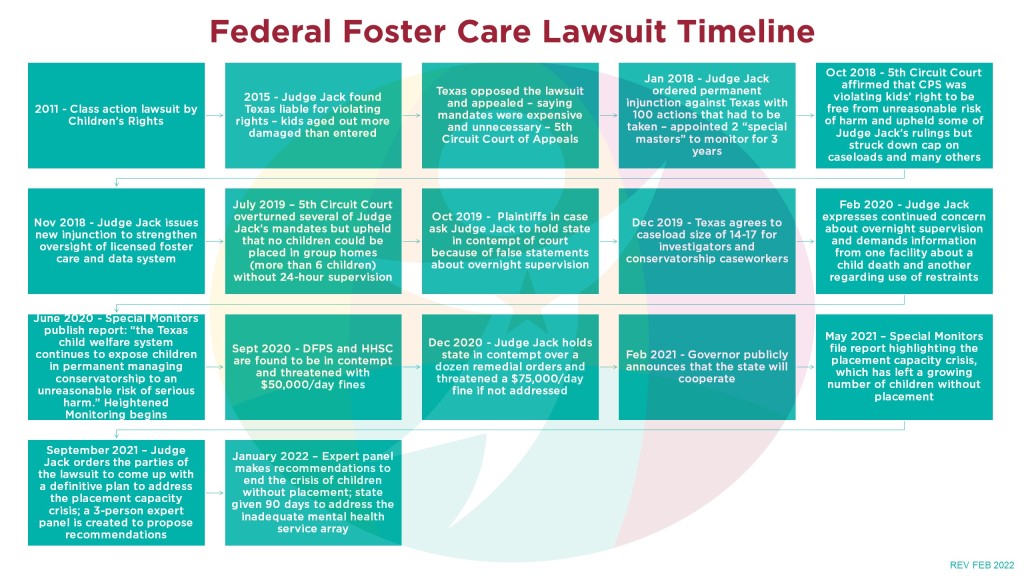
TexProtects continues to follow the latest developments on the foster care lawsuit. For the first time since the lawsuit began, Governor Greg Abbott publicly stated at the beginning of this month that the state would cooperate and that he would work with legislators this session to get the funding necessary to be in compliance with Judge Janis Jack’s orders.
Both the Department of Family and Protective Services (DFPS) and the Health and Human Services Commission (HHSC) included Exceptional Items for a total of almost $75 million above their base budgets to cover the expenses of the lawsuit. A supplemental request now increases that number to more than $126 million for the 2022-2023 biennium. In a session where state agencies have had to scale back spending and are trying to maintain service levels without cutting supports to children and families, finding $126 million in the Article II Health and Human Services budget will be no easy task.
For the sake of child safety, we are glad to see this shift in Governor Abbott’s approach to the lawsuit. It is also critical that Texas comply with the remedial orders ongoing from a financial perspective. Every possible fine and every dollar spent on this lawsuit, while necessary to keep kids in the system safe, is costing the state a lot of money. This has the potential of taking away necessary services for children and families from other areas of the agencies’ budgets and hinders opportunities to make smarter investments in new, innovative, and effective strategies.
Read the complete Dallas Morning News article here and check out TexProtects’ full statement on Governor Abbott’s public response.

In our last update in July 2020, we brought you up to speed on the findings in the Special Monitors report to Judge Jack, which showed how practices by both DFPS and HHSC were still placing the children in state custody at an unreasonable risk of harm. Since this time, the state has been held in contempt and threatened with hefty daily fines for not complying with more than a dozen of the Judge’s remedial orders, including the failure to comply with:
Governor Abbott spoke out in December 2020 soon after these findings and directed both state agencies to comply.
The 87th Texas Legislative Session is underway, and both the House and Senate have released their proposed budgets for the upcoming 2022-2023 biennium. With more revenue available than expected, the Department of Family and Protective Services (DFPS) fared pretty well when compared to other Health and Human Services agencies in the Article II budget. While the two chambers had different approaches to spending, they both proposed providing DFPS with a total of $4.4 billion in All Funds, including over $13 million in General Revenue.
The best news in the DFPS budget is that prevention funds were maintained and, in some cases, strengthened in both the House and Senate base budgets. Increased federal funding as well as efficiencies in Prevention and Early Intervention Programs (PEI) resulted in slight increases to the STAR program, child abuse prevention grants, and home visiting programs. As prevention programs have been especially vulnerable in prior recessions, this is great news for the start of the 87th session as we continue to advocate for strategic growth and smart investments in prevention.
Unlike prior sessions, the House and Senate budgets begin with a host of similarities. Unfortunately, in general, many of those similarities reflect a maintenance of the status quo. Both chambers introduced budgets that fail to make meaningful investments to improve:
And in some cases, the budgets are aligned in ways that could result in decreased quality in DFPS operations. For example,
Despite being overwhelmingly similar, there are some key differences in the House and Senate budgets.
The budget is the single most important piece of legislation each session and is the only task that the legislature is required to complete. Lawmakers’ priorities and funding decisions determine if agencies will be able to provide appropriate and timely services and ensure the best outcomes. Members of the House and Senate still have work to do to reconcile the differences between their proposed budgets and consider what is most important for the safety and well-being of children and families. We encourage you to get involved in the House Appropriations and Senate Finance process as they continue to determine what the budget will look like for the upcoming biennium. The Senate Finance Committee will be hearing invited testimony on February 25th and allowing public comment on March 1st. It is critical that we encourage lawmakers to invest in the health and success of children and families by educating legislators on what works, what doesn’t, and the benefits of investing in smart solutions.
For guidance and resources on how you can champion child protection this legislative session, visit our website and sign-up to receive our advocacy alerts by texting TEXPROTECTED to 25994.
The 87th Legislative Session kicked off last week and after a flurry of activity Tuesday through Thursday, both houses adjourned until January 26, 2021. Here are the five key developments last week that will affect advocacy efforts this session.
1. Safety protocols: The State Preservation Board released the following adjustments to protocols for the 87th legislative session.
2. Money: On Monday, Texas Comptroller Glenn Hegar unveiled the biennial revenue estimate, which revealed a better-than-expected outlook for budget writers this session. In short, there is a $946 million shortfall in the current budget. Budget writers will have $112.53 billion to appropriate for the 2022-2023 biennial budget – a 0.4% decrease from the last session. In hand, Texas has an additional $11.6 billion in the Economic Stabilization (or Rainy Day) fund and $13 billion in federal CARES Act Allocations that could replace General Revenue spending this biennium decrease shortfall. Despite continued uncertainty due to energy revenue, public health, and revenue through the end of this budget cycle, the estimate made clear that this legislation should have the tools necessary to maintain, if not strengthen, critical supports for children and families.
3. Leadership: On opening day, the House elected Rep. Dade Phelan, the Speaker of the House. Rep. Phelan is a Republican from Beaumont who has served in the House since 2015 and had bipartisan support in his election as Speaker. He rounds out the “Big Three” leaders in Texas, including the publicly-elected Governor and Lieutenant Governor who preside over the Senate.
4. Rules: Both houses, last week, adopted adjusted rules for the upcoming session, largely to address adaptations required by the public health considerations surrounding COVID-19 and their implications on the legislative process. The Senate took a much more aggressive approach to requirements for COVID-tests. Neither House adopted provisions to allow virtual testimony beyond what is currently allowed for invited witnesses.
On Friday, the Senate posted their committees. Key committee leadership was maintained with Sen. Jane Nelson (Republican) chairing Finance and Sen. Lois Kolkhorst (Republican) chairing Health and Human Services. The Speaker will be accepting preference cards from House members regarding committee assignments through January 22. We can expect House Committees to be announced in the weeks following.
The TexProtects team is committed to bringing you the latest information on child welfare this legislative session, so stay connected to our resources by signing up to receive our newsletter or follow the conversation on Twitter using the hashtag #TexProtected
Let’s all be champions for children this session!
The 87th Legislative Session is underway, and with it comes the opportunity to fight for smart solutions to child abuse and neglect. Now more than ever, the TexProtects policy team is laser-focused on strategies that strengthen families, prevent child abuse, and promote healing during these times of exponential need.
COVID-19 has dramatically impacted our already vulnerable child protection system, put unimaginable strain on families with young children, and exacerbated root causes of child maltreatment like substance use and behavioral health concerns. 5,300 more children may be at risk of entering the Texas foster care system as a result and many more will be impacted. Texas cannot afford that additional $4.4 billion price tag nor can our children. Texas must invest in proven programs that prevent abuse and save $1.26-$8.08 per $1 invested by supporting community and family efforts to create safe and nurturing environments for the 7.5 million children who call Texas home. Together, it is time to do more of what works and less of what doesn’t for Texas children and their families across party lines. [link full agenda]

Sophie Phillips, TexProtects CEO, has a background in social work. Her passion and interest are in addressing the root causes of child abuse and neglect and creating partnerships to advance state policies and practices.

Jennifer Lucy, Managing Director of Programs, provides leadership, strategy, and coordination for TexProtects policy, research, education activities, and staff. She partners with legislators, staff, and community partners to execute a policy agenda that prevents child abuse and neglect and helps families thrive.

Kerrie Judice, CPS Researcher and Analyst, monitors key CPS and Foster Care issues for the team. Her prior experience as a worker in the CPS system and connections to other child protection partners provides invaluable insight as she advocates for improvements to the Texas child protection system.

Michelle Wittenburg is an external lobbyist whose strategic consultation and connections to the movers and shakers in the Capitol are an invaluable resource to TexProtects.

Jess Trudeau serves as the Director for the Texas Prenatal to Three Collaborative while providing coordination and direction for policy, advocacy, and funding efforts to support Family Connects.

Beth Cortez-Neavel provides organizational and administrative support for the policy team. She uses her journalism background to communicate the most important issues for child protection advocates.

Gloria manages communications strategies for TexProtects and the Texas Prenatal to Three Collaborative. Her goal is to connect the community to our policy recommendations and educational resources.
Safeguarding today’s children from abuse and neglect is essential to protecting tomorrow’s Texas. If you want to get involved in the process, we put together some ways you can take action today. The TexProtects team is committed to resourcing you well to use your voice to be a champion for children. Please don’t hesitate to contact our team with questions. We are here for you!