
Smart solutions to child abuse and neglect were put forward by TexProtects during the legislative session, including accomplishments, missed opportunities.
Type: Resources

86th Texas Legislature Update: Mid-April
The 86th Texas Legislature is almost two-thirds complete. Here is the status of the major bills TexProtects is supporting:
The Fiscal Years 2020-21 Budget (House Bill 1)
Our major goal for the 86th Legislature is to secure increased investments in family support home visiting programs – specifically an additional $12 million for Nurse-Family Partnership (NFP) and $18.5 for the HOPES (Healthy Outcomes through Prevention and Early Support) program. The majority of child maltreatment occurs in the most formative years for children and 75% of child abuse fatalities over the past five years were children under age 3. Texas needs these most proven and effective programs for reducing child maltreatment for children between the ages of 0-5. Currently both the House and Senate versions of the budget fall short of those goals.
Prevention
For Nurse Family Partnership, the Senate included an additional $2 million dollars. The House, thanks in large part to the efforts of Representatives Button and Meyer, added $5.8 million dollars to NFP. For Project HOPES, however, the House only included $1.5 million new dollars and the Senate didn’t appropriate any. The differences between the two versions will have to be ironed out in a conference committee between the two chambers. House conferees are Reps. John Zerwas, Greg Bonnen, Sarah Davis, Oscar Longoria and Armando Walle; Senate conferees will soon be appointed.
TexProtects will monitor negotiations between the House and Senate and will advocate for larger investments (thus reaching more families who would benefit) in the final budget.
Child Protective Services
Overall, the House version of the 2020-2021 biennial budget includes $3.9 billion (an increase of $311.8 million from 2018-2019) in Child Protective Services funding, while the Senate version includes $3.8 billion (an increase of $271.7 million from 2018-2019).
Included in these amounts is $2 billion in the House version and $1.9 billion in the Senate version for client services programs, including foster care, adoption subsidies, permanency care assistance payments, relative caregiver monetary assistance payments, and day care. The House appropriated funds for rate increases for certain foster care providers. Both the House and Senate included $1.6 billion for CPS direct-delivery staff, including services provided through Community-Based Care. This amount includes increased funding to maintain lower caseloads for most caseworkers – the House version would reduce caseloads for conservatorship caseworkers, and the Senate version would reduce caseloads for conservatorship, kinship, foster and adoptive developmental home (FAD) and residential child care investigators. The House version expands Community-Based Care into two new regions and into stage 2, which includes case management, in Region 3B. The Senate version expands Community-Based Care into two new regions and into stage 2 in Regions 3B, 2, and 8A.
Behavioral Health Services
The House appropriated $4.1 billion (an increase of $665.4 million) while the Senate included $3.1 billion (a decrease of $275.9 million) for behavioral health services at the three health and human services agencies, which includes funding for community mental health services; mental health services for veterans; inpatient mental health services at state-owned and community hospitals; and substance abuse prevention, intervention, and treatment services.
Early Childhood Intervention (ECI)
Finally, funding for Early Childhood Intervention services totals $372.8 million (an increase of $83.4 million) in the House version for the 2020–21 biennium. The Senate appropriated $313.1 million for ECI services, representing an increase of $23.7 million.
Non-Budget Bills
HB 3718 (Rep. Tan Parker with Reps. Zerwas, Huberty, Miller, and Senfronia Thompson): This bill would require school districts and open-enrollment charter schools to implement a trauma-informed care policy (including staff training) and incorporates trauma-informed training into the existing continuing education hours teachers complete each five years. This bill is part of TexProtects’ call for a statewide strategy to mitigate and prevent trauma from Adverse Childhood Experiences and other sources of trauma. On April 11, HB 3718 was reported favorably from the House Public Education Committee, and now, it should head to the full House for a vote.
HB 4183 (Rep. Tan Parker with Reps. Zerwas, Miller, Sanford and Senfronia Thompson): This bill is key to our Adverse Childhood Experiences campaign, requiring multiple state agencies across the child protection, justice, education and health care systems to create a statewide strategy for preventing and mitigating ACEs. Testimony on HB 4183 was heard in the House Public Health Committee on April 3 and was voted out favorably on April 15. We look forward to a House vote on the bill soon.
Senate Bill 355 (Sen. Royce West with Sens. Kolkhorst, Lucio and Menéndez): SB 355 tasks DFPS with creating a strategic plan to maximize prevention funds available through the Federal Family First Prevention Services Act. Family First marks a key shift in federal policy, allowing money that was previously reserved strictly for foster care (in other words, after a tragedy has occurred) to be directed toward programs designed to prevent children from ever needing foster care (before tragedy occurs). Funds can be used for evidence-based substance use prevention and treatment, mental health care, and in-home parenting programs to strengthen families so that children can remain safely at home. SB 355 passed the Senate on March 20 and is currently in the House Human Services Committee.
HB 12 (Rep. Sarah Davis): This bill strengthens the Early Childhood Intervention Program by streamlining processes to receive services, requiring health benefit plans to cover services, creating a tele-health pilot to increase access, and requiring the ombudsman office to collect data on complaints and make recommendations on how to improve the provision of services. HB 12 received a hearing in the House Human Services Committee on April 9 and was left pending in committee.
HB 18 (Rep. Four Price and others): In response to ongoing concerns with school safety as well as recommendations from the House Select Committee on Mental Health, HB 18 provides students and educators with training and resources on mental health and substance use. Included in this very comprehensive bill is language that would ensure that trauma-informed practices are integrated into school environments and included in teachers’ continuing education. HB 18 has made it through the House and is on its way to the Senate.
HB 474 (Rep. Donna Howard): HB 474 will expand the data that is available as part of the foster care needs assessment to better understand where there are service gaps affecting pregnant and parenting foster youth. In addition to collecting information on prenatal, postpartum, or parenting supports for youth, it also collects information on placements that will be reimbursable under the Family First Prevention Services Act, including: licensed residential family-specialized substance use treatment facilities; qualified residential treatment programs; supervised independent living; and settings specializing in serving survivors of human trafficking. HB 474 will be considered by the House Human Services committee this week.
HB 475 (Rep. Donna Howard): Ensures pregnant and parenting youth in care receive basic parenting education and services that will help strengthen and preserve their young families. HB 475 specifically will make available to these youth information on: safe sleeping arrangements; recommendations for safety childproofing their home; methods to manage crying infants; the selection of appropriate substitute caregivers; early brain development; the importance of meeting an infant’s developmental needs by providing positive experiences and avoiding adverse experiences; the importance of paternal involvement; the benefits of reading and talking to young children; and the impact of perinatal mood disorders. HB 475 will be considered by the House Human Services committee this week.
HB 1110 (Rep. Sarah Davis): This bill expands Medicaid coverage for pregnant women from 60 days after the birth of a child to 12 months after delivery. This ensures that new mothers have access to critical health care in the postpartum period to increase health outcomes for moms and children. HB 1110 received a hearing in the House Human Services Committee on April 9 and was left pending in committee.
HB 2030 (Rep. John Turner): This bill provides that if a child is eligible for pre-K at 3 years old, they remain eligible at 4 years old. The House Public Education Committee passed a committee substitute version of the bill and reported it favorably to the full House.
HB 2832 (Rep. Dade Phelan): This bill requires the Health and Human Services Commission to work with the Department of Family and Protective Services to promote and track referrals to Nurse-Family Partnership programs. HB 2832 received a hearing in the House Human Services Committee on April 2 and was left pending in committee.
SB 708 (Sen. Judith Zaffirini with Sen. Campbell): This bill ensures that HHSC and other stakeholders have access to critical data on child safety. This bill directs the commission to collect data on caregiver-child ratios and group size standards as well as serious violations and injuries. This information will allow leaders to better understand if state minimum standards are sufficient to ensure that enrolled children are being cared for in supportive and safe environments. HB 708 received a hearing on April 16 and was left pending.
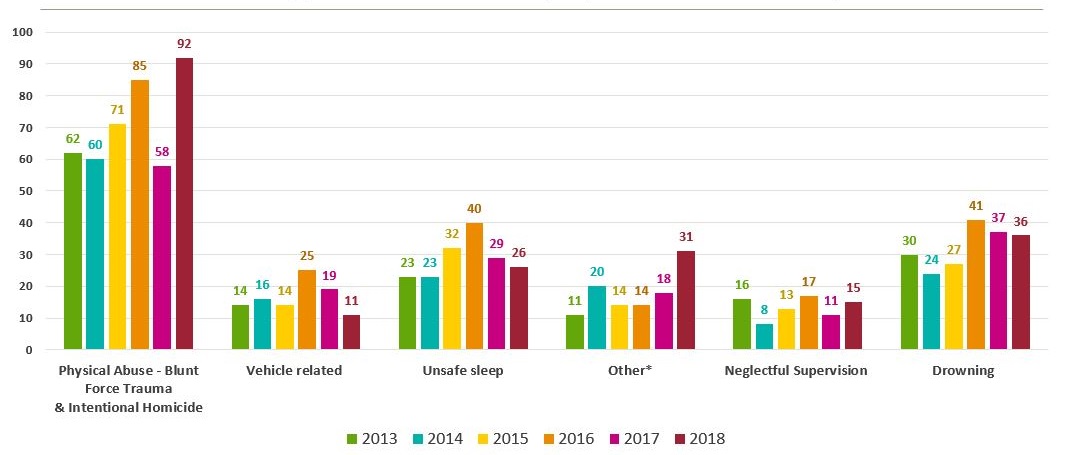
2018 Child Abuse Data Shows Deaths on the Rise
This past week, the Texas Department of Family and Protective Services made two important releases: An update of Fiscal Year 2018 Data Book information and its Child Maltreatment Fatalities and Near Fatalities Annual Report.
Below are some of the most significant numbers and trends that will be useful to you as a child protection advocate.
DFPS Data Book Trends (Fiscal Year 2018)
Between FY 2017 and 2018 in Texas:
- The number of child abuse victims increased to 66,352 in 2018 from 63,657 in 2017. Nearly 42% of the victims were under the age of 3.
- The number of children removed from their biological homes increased by 9.7%.
- There were increases in the number of children placed in foster care (1.48%) and emergency shelters (4.13%), but more children also being placed in kinship care (4.06%).
- There were increases in children entering care with higher levels of need: psychiatric (17%), intensive (17.4%), specialized (6.83%).
- The number of families that entered Family Based Safety Services decreased by 19.8%.
Long-term trends:
- Children entering foster care increased about 5% on average each year in the past decade.
DFPS Child Fatality Report
- Texas had 211 confirmed child abuse and neglect-related fatalities in FY2018, an increase of 22.7% compared to FY2017 (172). 36% of the victims were infants and 69% were under the age of three.
- The increase in child maltreatment fatalities in FY2018 is predominantly due to physical abuse fatalities which grew by 58% over FY2017.
- In FY2018, Texas had 82 confirmed abuse and neglect-related near-fatalities, a decrease of 11.8% compared to FY2017.
- The largest decrease was in non-fatal drownings, which dropped 33.3% compared to FY2017.
- Vehicle-related deaths continue to decline and did so by 42% in FY2018. Examples of vehicle-related deaths include a child left in a hot car, a child unsupervised and struck by a vehicle, and a child riding in a car where the parent or caregiver driving was intoxicated or under the influence.
- From FY2017 to FY2018 there was a 25% increase in child fatalities caused by abuse or neglect involving a parent or caregiver actively using a substance and/or under the influence of at least one substance that affected the ability to care for the child.
- Abusive head trauma accounted for 45.1% of the total number of near-fatalities.

Obviously, the increase in fatalities deeply troubles us, especially after the attention lawmakers paid to child maltreatment in the 2017 legislative session.
The 2017 session must not be viewed as an end point in the struggle against child maltreatment, but rather as a beginning. There are still profound challenges ahead in the ongoing 2019 session.
While the focus two years ago was heavily on Child Protective Services and foster care – the systems that pick up the pieces after tragedy has occurred – this session there needs to be an even greater emphasis on strengthening families before a crisis can happen.
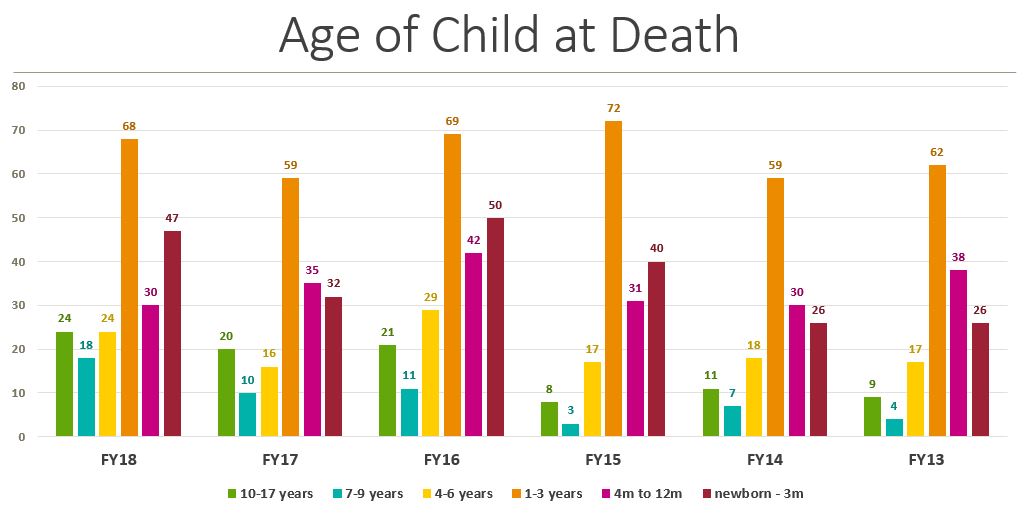
The increase in fatalities are alarming and a call to action for greater emphasis on prevention and early intervention, especially at the youngest ages.
A combination of numbers that stands out to us:
- Unlike fatalities that occurred the previous year, in 2018 the majority of fatalities due to abuse and/or neglect included families with no prior CPS history.
- Additionally, the number of fatalities occurring from newborn to age 3 is on the rise, and so are the deaths caused by blunt force trauma – and those youngest ages are when children are most vulnerable to such violence, including abusive head trauma.
These are ages when new families can be under the most stress and have the least understanding of early childhood development – and the ages at which most home visiting (prevention) programs are targeted. If we can reach more of these families with home visiting and other parent education and tools, we can avert such tragic incidents.
To this end, these are TexProtects’ top priorities at the Capitol this spring:
- Strengthening investments in community-based, primary child abuse prevention programs – specifically, a combined increase of $30.5 million toward Nurse-Family Partnership and the HOPES (Healthy Outcomes through Prevention and Early Support) Program to reach 3,600 additional eligible families
- Developing a Texas plan to implement the provisions of the federal Family First Prevention Services Act, which would shift state investments toward services and resources that keep children out of foster care (Senate Bill 355)
- Developing and implementing a statewide, strategic public health approach to address causes and symptoms of Adverse Childhood Experiences (House Bill 4183)
- Implementing trauma-informed care training and policies in public schools (House Bill 3718)
TexProtects will continue to be at the Capitol, making the case for prevention to lawmakers every day, meeting them in their offices, providing them with research, and testifying in committees. Thank you for the support you’ve provided to our mission, including the emails you’ve sent to legislators this session. Check your inbox for future advocacy opportunities!

ACEs Uncovered
Preventative strategies to promote resilience and brain health in children in Texas.