TexProtects applauds passage of SB 355 (re Family First Prevention Services Act)

FOR IMMEDIATE RELEASE
May 22, 2019
Contact: Lee Nichols
512-796-9877
[email protected]

Austin, Texas — Earlier today, the Texas House passed Senate Bill 355 by Sen. Royce West (sponsored in the House by Rep. Stephanie Klick). This bill directs the Department of Family and Protective Services to develop a strategic plan for the coordinated implementation of community-based care and foster care prevention services that meet the requirements of the federal Family First Prevention Services Act.

TexProtects (the Texas chapter of Prevent Child Abuse America) applauds the passage of this bill by both chambers, resulting in SB 355 being sent to Governor Greg Abbott to be signed into law. Statement from TexProtects Vice President of Public Affairs Pamela McPeters:

We applaud the House for swiftly passing this key piece of legislation and sending it to the governor. The Family First Prevention Services Act marked a major shift in federal spending priorities, allowing money that previously was reserved solely for foster care to now be invested in crucial prevention programs that keep children from ever being removed from their families in the first place – safely protected in their homes. Senate Bill 355 will allow the state to develop a Texas strategy to leverage and maximize these funds for services that empower families to be resilient and self-reliant. FFPSA is a landmark recognition that we must support families before tragedy can occur, not just after it happens.

The Perfect Mother’s Day Gift: Home Visiting

By Sophie Phillips, CEO, TexProtects

Six Mother’s Days have passed since I’ve been with TexProtects, the Texas chapter of Prevent Child Abuse America. All were meaningful, because mothers are central to our mission, but this one deepened my perspective – it’s my first as a mother.

In our efforts to prevent trauma from abuse and neglect, TexProtects promotes and builds effective policies and programs helping new mothers and families deal with the life-changing stresses that come with newborns and young children.

Now, through seemingly never-ending late-night feedings, cries you just can’t soothe and frantic internet searches looking for answers to unanticipated questions, I understand how crucial this is. This precious little gift is a great responsibility that would be difficult to handle alone.

I am fortunate and grateful to have my husband at my side every step of the way, family nearby, a supportive church, steady income and paid leave, and good health during my life’s most meaningful and joyful, yet challenging experience. I spent years meticulously planning for this moment, including a wealth of knowledge gleaned from my career.

I thought I was prepared.

These first weeks of my baby’s life have shown me how fortunate I am. The resources and supports shown to me during this transition are not something I take for granted, because I know there are many new mothers across Texas in very different circumstances.

Some are very young. Many are alone – maybe kicked out of their homes or fleeing from an abusive situation. Some are struggling with postpartum depression or mental illness or fighting their way out of addiction. They may lack confidence, parenting knowledge, or reliable relationships to help, especially if their own parents abused or neglected them.

Abuse and neglect are cyclical. These mothers’ situations do not predetermine that their children will be abused or neglected – but they dramatically raise the odds. Helping these mothers is key to breaking that cycle.

One of the best ways to do this is through evidence-based home visiting programs. These are nonprofit programs in the community, in which a family with newborns or young children can invite a nurse, social worker or other trained professional into the home to provide support and make referrals when needed.

Home visiting has proven benefits: fewer pregnancy complications; reduced incidences of domestic violence, child maltreatment, and interaction with the judicial system; better educational and health outcomes (both for the parent and child); and a greater likelihood that the parent(s) will become or remain employed. In other words – stronger, more resilient, self-sufficient families.

The programs have another beneficiary – taxpayers. Helping these families avoid tragic situations and stay out of the Child Protective Services and foster care systems relieves pressure on the emergency services, judicial, health, and education systems.

In the current Texas Legislative session, which ends May 27, the competing House and Senate versions of the proposed Fiscal Years 2020-21 budget both have very modest increases in state investments in home visiting – but not nearly enough to substantially increase the number of families served.

Of 423,000 Texas families we estimate could benefit from home visiting, having young children with multiple risk factors, Texas currently can serve only about 15,000.

The actual need is much greater. On paper I may not look like I need home visiting, but following my son’s birth, I most certainly did. All new mothers could use some help.

With the $30.5 million legislative investment increase requested by TexProtects, we could help another 3,600 families. Home visiting programs have demonstrated returns ranging from $1.26 to $8.08 per dollar invested – failure to reach those families means lives lost and tax savings missed.

Please urge lawmakers negotiating the final budget bill to substantially increase home visiting investments. Mother’s Day shouldn’t be a reminder of traumatic childhoods or maternal inadequacies. Help us cement Mother’s Day as a celebration of strong families and abundant love for our children.

Sophie Phillips is CEO of TexProtects – Champions for Safe Children. www.texprotects.org.

This op-ed was published May 10 in the San Antonio Express-News.

Learn more:

Information about Home Visiting

TexProtects’ Agenda for the 86th Texas Legislature

‘What happened to you?’ – Rep. Tan Parker on Adverse Childhood Experiences

State Rep. Tan Parker has been a champion at the Texas Legislature this session in the drive to help prevent and mitigate the effects of Adverse Childhood Experiences, including authoring this op-ed, which was published in the Houston Chronicle and Galveston County Daily News. His House Bill 4183 is key to this effort, as he explains below.

“What’s wrong with you?”

That’s a common question we ask when children act in a self-destructive manner. Maybe they’re being disruptive in class, misbehaving regularly, hurting themselves or even having violent thoughts.

growing body of research suggests that “What’s wrong with you?” is actually the incorrect question. The better one is: “What happened to you?”

It has been widely known traumatic experiences suffered early in life — known as Adverse Childhood Experiences (ACEs) — can leave deep emotional scars. But many studies now show that the effects of trauma can be even more profound than previously believed. These experiences can actually disrupt healthy development and change a child’s brain architecture in ways that impact behavior and health throughout an entire life.

Recognized ACEs include child abuse and neglect, death of a parent, having a parent with a mental illness, an incarcerated parent or caregiver, substance use and family violence. Sadly, it’s estimated that 24 percent of Texas children have experienced multiple ACEs.

That’s a serious public health crisis that requires a cross-systems, comprehensive strategy to solve.

To that end, I have partnered with TexProtects (the Texas Chapter of Prevent Child Abuse America) to make that vision a reality by authoring House Bill 4183 to address the challenges that ACEs pose to our children.

ACEs are often cumulative — exposure to one increases the likelihood of exposure to others. Researchers have found compound exposure increases the likelihood of suicide, depression, substance use, obesity, smoking and leading causes of early death such as stroke, heart attack, cancer and diabetes. Among Texas children with multiple ACEs, 17.2 percent have repeated a school grade (compared to 2.7 percent of children with none), 31 percent are more likely to have two or more chronic health conditions (compared to 10.5 percent with none) and 59 percent have no consistent, comprehensive medical care.

But childhood adversity does not have to dictate a child’s future health and success. By appropriately addressing ACEs (as well as root causes), children and families can build resiliency, allowing them to thrive despite adversity. Research shows a supportive, responsive relationship with an adult in early life can prevent or mitigate the damaging effects resulting from childhood exposure to chronically stressful experiences.

Under HB 4183, Texas would deploy a strategy coordinated across state agencies, child well-being and faith-based organizations, neighborhood schools, local medical and mental health service providers, criminal and juvenile justice and the philanthropic community. By bringing together stakeholders from multiple domains, Texas will be able to better understand the prevalence and patterns of adversities in Texas communities, identify best practices and service gaps and chart a path forward so that Texas systems and communities are better prepared to implement approaches that can truly change the trajectory for the estimated 3.4 million Texas children experiencing ACES.

A blueprint for our communities may include strategies to train and educate professionals to prevent and assess for ACEs, then referring for effective services; providing trauma-informed behavioral counseling; providing high-quality early childhood education; making available voluntary programs that strengthen parenting skills; identifying best practices for Child Protective Services; and successfully treating mental illness and substance abuse disorders.

The economic impact of ACEs is staggering. Child abuse and neglect alone will cost Texas taxpayers an estimated $1.75 billion for Child Protective Services in 2019. The lifetime costs of abuse and neglect victims in 2018 — across the education, health care, criminal justice and welfare systems, as well as lost future earnings in the workforce — will add up to more than $58 billion, based on estimates provided by the U.S. Centers for Disease Control.

Every year Texas waits, those billions accumulate, more lives are damaged, and we ultimately pay a much higher price.

Rep. Tan Parker represents District 63 (Denton County).

To learn more about Adverse Childhood Experiences, see our report at http://bit.ly/acesuncovered


Reasons I’m HOPEful…

Why are you hopeful for Texas children and families? That’s the question we’re asking as we launch our #TexProtectsHOPEful social media campaign during Child Abuse Prevention Month – and continuing well beyond April! This campaign celebrates the efforts of good people all over the state working to prevent and protect children from abuse and neglect!

We got a great answer from Michelle Heflin of Buckner International, the nonprofit that administers the Project HOPES program in Gregg, Upshur and Harrison Counties. So great, in fact, that it deserves more than just a Tweet, so we present it here as a full blog post. Enjoy!

In July 2014, I welcomed my first child into the world and quickly realized that for the past 10 years of my professional career in social services I may have been giving impractical parenting advice to parents and foster parents. It was not intentional, but when you’re in the parenting trenches and the 2am wake-up cry has you sleep-deprived, you quickly learn it’s a whole other ball game – theory versus practice.

Shortly after my initiation into motherhood, the nonprofit I work for, Buckner International (www.Buckner.org), was awarded the Project HOPES contract in September 2014 for the Texas counties of Gregg, Upshur and Harrison from the Prevention and Early Intervention Division of the Department of Family and Protective Services. We selected the Parents as Teachers home visiting (0-5 yrs.) program, which focuses on parents being the first teacher of the child through developmental milestones and school readiness.

Through the program, I found that the information delivered to families really pertained to being a new parent and parents confirmed their feeling of support by having a plan for those 2am wake-up cries. Accurate information about child development and appropriate expectations for children’s behavior at every age helps parents see their children in a positive light and promote their healthy development.

Why is parent education so important for the prevention of child abuse or maltreatment? Because having (1) Knowledge of Parenting and Child Development is just one of the Five Protective Factors within families.

The other Protective Factors include:

(2) Parental Resilience – No one can eliminate stress from parenting, but a parent’s capacity for resilience can affect how a parent deals with stress.

(3) Social Connections – Networks of support are essential to parents and also offer opportunities for people to “give back,” an important part of self-esteem as well as a benefit for the community.

(4) Concrete Support in Time of Need – Meeting basic economic needs like food, shelter, clothing and health care is essential for families to thrive.

(5) Social and Emotional Competence of Children – Challenging behaviors or delayed development create extra stress for families, so early identification and assistance for both parents and children can head off negative results and keep development on track.

There is a correlation between low Protective Factors within families and the prevalence of child abuse or neglect. If we are going to prevent or lower the child abuse rates in our communities and therefore potentially decreasing the need for children to be removed from their home, this is the key.

I’m hopeful for the children in our community because parents that engage with Buckner Project HOPES (www.Buckner.org/Project-HOPES) to increase Protective Factors have also taken on tasks of reaching goals within their family. Goals like obtaining an associate’s degree then moving onto a bachelor’s degree, securing more stable housing, moving from underemployment to a living wage and feeling better prepared to parent.

It has been my observation that many of these goals are accomplished because they first felt successful as a parent! When families are strengthened and are mutually responsible for better outcomes for their children, that is the essence of the meaning of our slogan at Buckner International: “Hope shines here.”®

For more information on Project HOPES, click here.

Tell us in the comments – why are you #TexProtectsHOPEful?

86th Texas Legislature Update: Mid-April

The 86th Texas Legislature is almost two-thirds complete. Here is the status of the major bills TexProtects is supporting:

The Fiscal Years 2020-21 Budget (House Bill 1)

Our major goal for the 86th Legislature is to secure increased investments in family support home visiting programs – specifically an additional $12 million for Nurse-Family Partnership (NFP) and $18.5 for the HOPES (Healthy Outcomes through Prevention and Early Support) program. The majority of child maltreatment occurs in the most formative years for children and 75% of child abuse fatalities over the past five years were children under age 3. Texas needs these most proven and effective programs for reducing child maltreatment for children between the ages of 0-5. Currently both the House and Senate versions of the budget fall short of those goals.

Prevention

For Nurse Family Partnership, the Senate included an additional $2 million dollars. The House, thanks in large part to the efforts of Representatives Button and Meyer, added $5.8 million dollars to NFP. For Project HOPES, however, the House only included $1.5 million new dollars and the Senate didn’t appropriate any. The differences between the two versions will have to be ironed out in a conference committee between the two chambers. House conferees are Reps. John Zerwas, Greg Bonnen, Sarah Davis, Oscar Longoria and Armando Walle; Senate conferees will soon be appointed.

TexProtects will monitor negotiations between the House and Senate and will advocate for larger investments (thus reaching more families who would benefit) in the final budget.

Child Protective Services

Overall, the House version of the 2020-2021 biennial budget includes $3.9 billion (an increase of $311.8 million from 2018-2019) in Child Protective Services funding, while the Senate version includes $3.8 billion (an increase of $271.7 million from 2018-2019).

Included in these amounts is $2 billion in the House version and $1.9 billion in the Senate version for client services programs, including foster care, adoption subsidies, permanency care assistance payments, relative caregiver monetary assistance payments, and day care. The House appropriated funds for rate increases for certain foster care providers. Both the House and Senate included $1.6 billion for CPS direct-delivery staff, including services provided through Community-Based Care. This amount includes increased funding to maintain lower caseloads for most caseworkers – the House version would reduce caseloads for conservatorship caseworkers, and the Senate version would reduce caseloads for conservatorship, kinship, foster and adoptive developmental home (FAD) and residential child care investigators. The House version expands Community-Based Care into two new regions and into stage 2, which includes case management, in Region 3B. The Senate version expands Community-Based Care into two new regions and into stage 2 in Regions 3B, 2, and 8A.

Behavioral Health Services

The House appropriated $4.1 billion (an increase of $665.4 million) while the Senate included $3.1 billion (a decrease of $275.9 million) for behavioral health services at the three health and human services agencies, which includes funding for community mental health services; mental health services for veterans; inpatient mental health services at state-owned and community hospitals; and substance abuse prevention, intervention, and treatment services.

Early Childhood Intervention (ECI)

Finally, funding for Early Childhood Intervention services totals $372.8 million (an increase of $83.4 million) in the House version for the 2020–21 biennium. The Senate appropriated $313.1 million for ECI services, representing an increase of $23.7 million.

Non-Budget Bills

HB 3718 (Rep. Tan Parker with Reps. Zerwas, Huberty, Miller, and Senfronia Thompson): This bill would require school districts and open-enrollment charter schools to implement a trauma-informed care policy (including staff training) and incorporates trauma-informed training into the existing continuing education hours teachers complete each five years. This bill is part of TexProtects’ call for a statewide strategy to mitigate and prevent trauma from Adverse Childhood Experiences and other sources of trauma. On April 11, HB 3718 was reported favorably from the House Public Education Committee, and now, it should head to the full House for a vote.

HB 4183 (Rep. Tan Parker with Reps. Zerwas, Miller, Sanford and Senfronia Thompson): This bill is key to our Adverse Childhood Experiences campaign, requiring multiple state agencies across the child protection, justice, education and health care systems to create a statewide strategy for preventing and mitigating ACEs. Testimony on HB 4183 was heard in the House Public Health Committee on April 3 and was voted out favorably on April 15.  We look forward to a House vote on the bill soon.

Senate Bill 355 (Sen. Royce West with Sens. Kolkhorst, Lucio and Menéndez): SB 355 tasks DFPS with creating a strategic plan to maximize prevention funds available through the Federal Family First Prevention Services Act. Family First marks a key shift in federal policy, allowing money that was previously reserved strictly for foster care (in other words, after a tragedy has occurred) to be directed toward programs designed to prevent children from ever needing foster care (before tragedy occurs). Funds can be used for evidence-based substance use prevention and treatment, mental health care, and in-home parenting programs to strengthen families so that children can remain safely at home. SB 355 passed the Senate on March 20 and is currently in the House Human Services Committee.

HB 12 (Rep. Sarah Davis): This bill strengthens the Early Childhood Intervention Program by streamlining processes to receive services, requiring health benefit plans to cover services, creating a tele-health pilot to increase access, and requiring the ombudsman office to collect data on complaints and make recommendations on how to improve the provision of services. HB 12 received a hearing in the House Human Services Committee on April 9 and was left pending in committee.

HB 18 (Rep. Four Price and others): In response to ongoing concerns with school safety as well as recommendations from the House Select Committee on Mental Health, HB 18 provides students and educators with training and resources on mental health and substance use. Included in this very comprehensive bill is language that would ensure that trauma-informed practices are integrated into school environments and included in teachers’ continuing education. HB 18 has made it through the House and is on its way to the Senate.

HB 474 (Rep. Donna Howard): HB 474 will expand the data that is available as part of the  foster care needs assessment to better understand where there are service gaps affecting pregnant and parenting foster youth. In addition to collecting information on prenatal, postpartum, or parenting supports for youth, it also collects information on placements that will be reimbursable under the Family First Prevention Services Act, including: licensed residential family-specialized substance use treatment facilities; qualified residential treatment programs; supervised independent living; and settings specializing in serving survivors of human trafficking. HB 474 will be considered by the House Human Services committee this week.

HB 475 (Rep. Donna Howard): Ensures pregnant and parenting youth in care receive basic parenting education and services that will help strengthen and preserve their young families. HB 475 specifically will make available to these youth information on: safe sleeping arrangements; recommendations for safety childproofing their home; methods to manage crying infants; the selection of appropriate substitute caregivers; early brain development; the importance of meeting an infant’s developmental needs by providing positive experiences and avoiding adverse experiences; the importance of paternal involvement; the benefits of reading and talking to young children; and the impact of perinatal mood disorders. HB 475 will be considered by the House Human Services committee this week.

HB 1110 (Rep. Sarah Davis): This bill expands Medicaid coverage for pregnant women from 60 days after the birth of a child to 12 months after delivery. This ensures that new mothers have access to critical health care in the postpartum period to increase health outcomes for moms and children. HB 1110 received a hearing in the House Human Services Committee on April 9 and was left pending in committee.

HB 2030 (Rep. John Turner): This bill provides that if a child is eligible for pre-K at 3 years old, they remain eligible at 4 years old. The House Public Education Committee passed a committee substitute version of the bill and reported it favorably to the full House.

HB 2832 (Rep. Dade Phelan): This bill requires the Health and Human Services Commission to work with the Department of Family and Protective Services to promote and track referrals to Nurse-Family Partnership programs. HB 2832 received a hearing in the House Human Services Committee on April 2 and was left pending in committee.

SB 708 (Sen. Judith Zaffirini with Sen. Campbell)This bill ensures that HHSC and other stakeholders have access to critical data on child safety. This bill directs the commission to collect data on caregiver-child ratios and group size standards as well as serious violations and injuries. This information will allow leaders to better understand if state minimum standards are sufficient to ensure that enrolled children are being cared for in supportive and safe environments. HB 708 received a hearing on April 16 and was left pending.

April Is Child Abuse Prevention Month!

2019 CAP Month_Social Covers_Facebook Mobile 640x312

April is here, and that means it’s national Child Abuse Prevention Month (CAPM)!

In 2017, TexProtects | Champions for Children also became Prevent Child Abuse Texas – the Texas chapter of Prevent Child Abuse America (PCAA). This year, PCAA and all of its state chapters are spreading the message: Preventing child abuse and neglect can be simpler than you think – often, all it takes to create great childhoods is to Do More of What You Love.

Yes, it’s that simple. By channeling your interests into the lives of children, your neighbors, and your community, you can uplift them and give them the strength and resiliency they need to thrive.

All parents want to provide for and nurture their child in a positive, healthy environment, but sometimes they need a little support along the way – and they don’t know how to ask for it. In a national survey, 94% of parents said they needed help of some kind; 86% said they would be grateful for services, childcare or other support. However, in a separate study, fewer than 20% of parents said they would actually seek help.

So what can you do?

46185738_2828272623856869_3472556504211521536_o
Love sports? Coaching a youth sports team can make a huge difference in children’s lives!
  • Love to read? Volunteer for an after-school reading program or book club – you’ll help kids meet new friends and spark their imaginations, too.
  • Love to cook? Give a new mom a break by bringing over dinner, offering to run an errand, or babysitting.
  • Love sports? Coach a youth sports team to teach kids the value of teamwork – they’ll learn how to trust teammates and themselves.
  • Love to play host or hostess? Host a kid-friendly BBQ or organize a block party so parents can socialize without the stress of finding a sitter – social connections with other parents help to establish a strong support network.
  • Want your voice to be heard? Contact your elected officials and urge them to support policies and programs that promote safe, healthy childhoods. (TexProtects can definitely help you with this: Just go to texprotects.org, look for the “Stay Updated!” box, and sign up to receive our legislative advocacy alerts. Also, see our 2019 Legislative Agenda and our Legislative Advocacy Portal.)

To see more of how Small Steps Can Make a Big Difference, visit this resource page by Prevent Child Abuse America.


2018 Child Abuse Data Shows Deaths on the Rise

This past week, the Texas Department of Family and Protective Services made two important releases: An update of Fiscal Year 2018 Data Book information and its Child Maltreatment Fatalities and Near Fatalities Annual Report.

Below are some of the most significant numbers and trends that will be useful to you as a child protection advocate.

DFPS Data Book Trends (Fiscal Year 2018)

Between FY 2017 and 2018 in Texas:

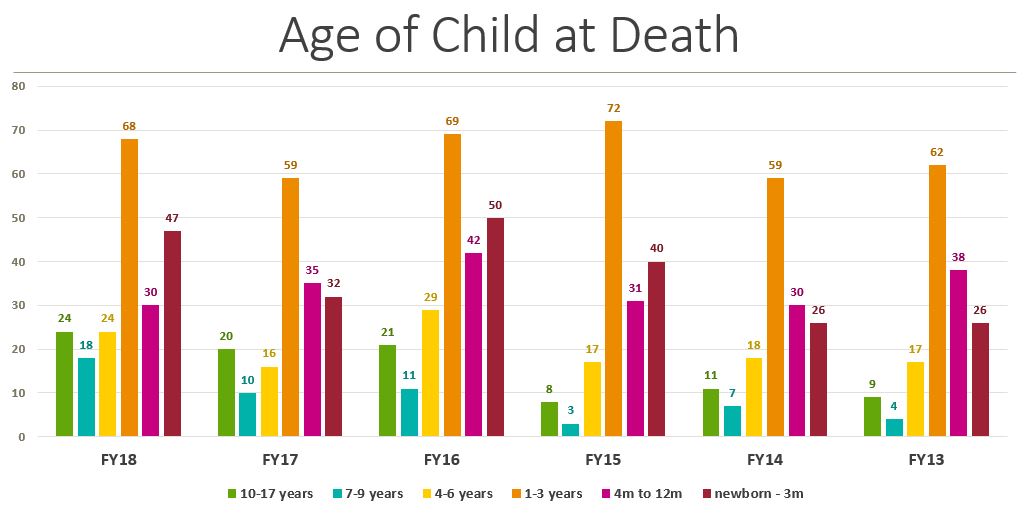
  • The number of child abuse victims increased to 66,352 in 2018 from 63,657 in 2017. Nearly 42% of the victims were under the age of 3.
  • The number of children removed from their biological homes increased by 9.7%.
  • There were increases in the number of children placed in foster care (1.48%) and emergency shelters (4.13%), but more children also being placed in kinship care (4.06%).
  • There were increases in children entering care with higher levels of need: psychiatric (17%), intensive (17.4%), specialized (6.83%).
  • The number of families that entered Family Based Safety Services decreased by 19.8%.

Long-term trends:

  • Children entering foster care increased about 5% on average each year in the past decade.

DFPS Child Fatality Report

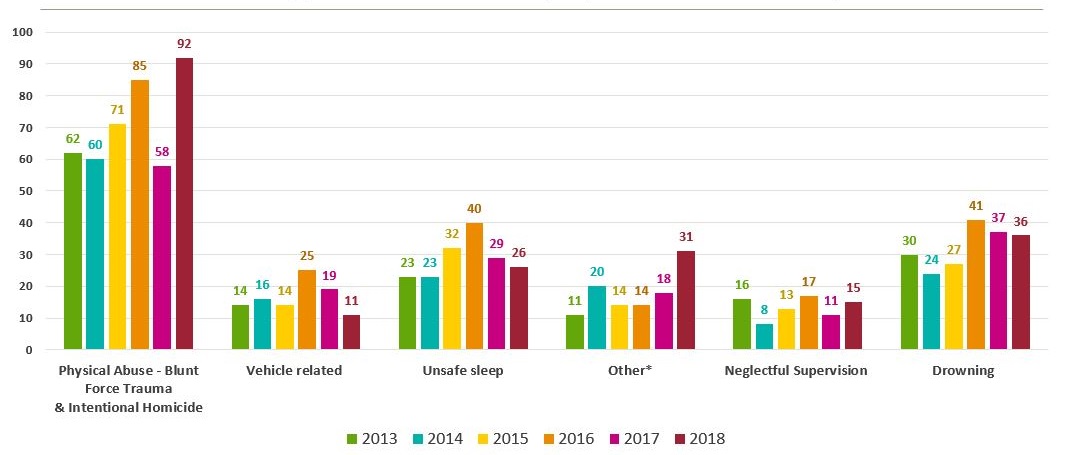
  • Texas had 211 confirmed child abuse and neglect-related fatalities in FY2018, an increase of 22.7% compared to FY2017 (172). 36% of the victims were infants and 69% were under the age of three.
  • The increase in child maltreatment fatalities in FY2018 is predominantly due to physical abuse fatalities which grew by 58% over FY2017.
  • In FY2018, Texas had 82 confirmed abuse and neglect-related near-fatalities, a decrease of 11.8% compared to FY2017.
  • The largest decrease was in non-fatal drownings, which dropped 33.3% compared to FY2017.
  • Vehicle-related deaths continue to decline and did so by 42% in FY2018. Examples of vehicle-related deaths include a child left in a hot car, a child unsupervised and struck by a vehicle, and a child riding in a car where the parent or caregiver driving was intoxicated or under the influence.
  • From FY2017 to FY2018 there was a 25% increase in child fatalities caused by abuse or neglect involving a parent or caregiver actively using a substance and/or under the influence of at least one substance that affected the ability to care for the child.
  • Abusive head trauma accounted for 45.1% of the total number of near-fatalities.

causes

Obviously, the increase in fatalities deeply troubles us, especially after the attention lawmakers paid to child maltreatment in the 2017 legislative session.

The 2017 session must not be viewed as an end point in the struggle against child maltreatment, but rather as a beginning. There are still profound challenges ahead in the ongoing 2019 session.

While the focus two years ago was heavily on Child Protective Services and foster care – the systems that pick up the pieces after tragedy has occurred – this session there needs to be an even greater emphasis on strengthening families before a crisis can happen.

age at death

The increase in fatalities are alarming and a call to action for greater emphasis on prevention and early intervention, especially at the youngest ages.

A combination of numbers that stands out to us:

  • Unlike fatalities that occurred the previous year, in 2018 the majority of fatalities due to abuse and/or neglect included families with no prior CPS history.
  • Additionally, the number of fatalities occurring from newborn to age 3 is on the rise, and so are the deaths caused by blunt force trauma – and those youngest ages are when children are most vulnerable to such violence, including abusive head trauma.

These are ages when new families can be under the most stress and have the least understanding of early childhood development – and the ages at which most home visiting (prevention) programs are targeted. If we can reach more of these families with home visiting and other parent education and tools, we can avert such tragic incidents.

To this end, these are TexProtects’ top priorities at the Capitol this spring:

  • Strengthening investments in community-based, primary child abuse prevention programs – specifically, a combined increase of $30.5 million toward Nurse-Family Partnership and the HOPES (Healthy Outcomes through Prevention and Early Support) Program to reach 3,600 additional eligible families
  • Developing a Texas plan to implement the provisions of the federal Family First Prevention Services Act, which would shift state investments toward services and resources that keep children out of foster care (Senate Bill 355)
  • Developing and implementing a statewide, strategic public health approach to address causes and symptoms of Adverse Childhood Experiences (House Bill 4183)
  • Implementing trauma-informed care training and policies in public schools (House Bill 3718)

TexProtects will continue to be at the Capitol, making the case for prevention to lawmakers every day, meeting them in their offices, providing them with research, and testifying in committees. Thank you for the support you’ve provided to our mission, including the emails you’ve sent to legislators this session. Check your inbox for future advocacy opportunities!

The State Budget: Building Upon Success

By Pamela McPeters
TexProtects Vice President of Public Affairs

The budget is one of the most significant responsibilities of the Texas Legislature. The Senate Finance and House Appropriations Committees of the 86th Legislature will soon be underway crafting the fiscal years 2020-2021 General Appropriations Act. As these committees work on competing interests, including school finance, Hurricane Harvey obligations and many others, it is imperative they prioritize the safety and well-being of Texas children. The child protective services system is experiencing increased pressure which requires investments to continue and build upon the progress made in the 85th Legislative Session. Pressure includes:

  • Abuse/neglect reports are projected to increase by 2.1% in FY 2020 over FY 2019 and 2.3% in FY 2021 over FY 2020.
  • Investigations are projected to increase by 2.5% in FY 2020 over FY 2019 and 2.6% in FY 2021 over FY 2020.
  • The number of confirmed findings of child abuse and neglect is projected to increase by 1.2% in FY 2020 over FY 2019 and 0.9% in FY 2021 over FY 2020.
  • Client Services Adoption Subsidies and Permanency Care Assistance caseloads are projected to grow 4.2% in FY 2020 and 8.6% in FY 2021 above FY 2019.
  • Day Care is projected to increase 7.1% children served in FY 2020 and a 13.5% in FY 2021 above the projected FY 2019 levels.
  • Purchased Client Services are projected to increase 5.0% in average monthly client caseloads in FY 2020 and 10.0% in FY 2021 above FY 2019.
  • Foster Care caseloads (FTEs) are projected to grow by 0.3% in FY 2020 and by 0.4% in FY 2021 relative to FY 2019 projected caseloads.

Below are some key priorities for funding:

#1 Expand Prevention Services (DFPS Exceptional Item 8)

Additional Details may be found on pages 534-536 of the Department of Family and Protective Services (DFPS) Legislative Appropriations Request (LAR)

$18.5 million to expand HOPES program into additional counties and increase families served from 4,660 families expected to be served in fiscal year 2019 to 7,060+ families served in fiscal years 20 and 21, an expansion of 26%.

Healthy Outcomes through Prevention and Early Support (HOPES) is a flexible, community-based approach to child abuse and neglect prevention in high-risk counties by increasing protective factors of families served. Currently serves families in 55 Texas counties with children ages 0-5 at risk for abuse and neglect. Families are commonly referred to HOPES by community organizations, clinics, school districts, or self-referral. Families generally participate in HOPES services for 3-12 months.

$12 million provide for a targeted expansion to increase the number of families served through Texas Nurse-Family Partnership from 2,725 families in fiscal year 2019 to 3,975+ families in fiscal years 2020 and 2021, a 20% increase.

Texas Nurse Family Partnership (TNFP) is a voluntary program in which registered nurses regularly visit the homes of low-income women pregnant with their first child. Families must start services with TNFP by their 28th week of pregnancy and can receive services until the child reaches two years of age. TNFP Serves expecting parents, new parents, and caregivers of children under the age of 2. Families are commonly referred by WIC, community clinics, school districts, and health plans. Families generally participate in TNFP services for two years.

#2 Maintain Client Services (DFPS Exceptional Item 2)

Additional Details may be found on pages 516-518 of the DFPS LAR

 $79.3 million for Day Care Services to address growth for fiscal years 2020 and 2021.

Day care services for children while biological parents are receiving services to preserve the family and/or when a child is placed with a relative, along with while a child is in foster care, increase safety. These services may provide for immediate or short-term safety from abuse and neglect; prevent the child from being removed from the home; allow the child to be reunited with the family; address the developmental needs of a child whose physical, social, emotional, cognitive, or language developmental delay is a significant factor in the risk of abuse or neglect in the home; and help stabilize the family.

 $52.3 million for Client Services for children and their families starting from intake, relative caregiver homes, foster and adoptive homes and post-adoption.

These services may include evaluation and treatment services, parent/caregiver training, and substance abuse assessments and treatment (individual, family and group counseling).

#3 CPS Initiatives and Operations (DFPS Exceptional Item 5)

Additional Details may be found on pages 525-530 of the DFPS LAR

$17.8 million to support CPS initiatives including, preparation for adult living skills assessment for older youth, determine eligibility, improve permanency and other frontline staff, case management for certain youth in extended foster care, services for children post-adoption and post-permanency, and medical services staff.

In addition, funding will support case management for youth with complex needs in extended foster care, behavioral health services to promote permanency, and support medical wellbeing.

 #4 Maintain Caseloads (Exceptional Item 1)

Additional Details may be found on pages 513-5515 of the DFPS LAR.

 $106 million to maintain average daily caseloads at manageable levels for CPS Investigations (13.9 cases), Conservatorship (23.1 cases), Foster/Adopt (17.3 cases), and Kinship (31.4 cases) and reduce statewide intake hold times by about half.

Here is a side-by-side comparison of key Child Protective Services line items from the House and Senate proposed budgets. After each chamber passes its respective version of the budget, they will then have to agree on a final version to send to Governor Greg Abbott.

House Bill 1 Senate Bill 1 Difference in SB1 from HB1 DFPS LAR Base Request DFPS Exceptional Item Request
2020-21 2020-21 2020-21 2020-21 2020-21
STATEWIDE INTAKE 45,903,260 45,903,260 0 45,903,260 16,868,045
A.1.1. Statewide Intake Services 45,903,260 45,903,260 0 45,903,260 16,868,045
CHILD PROTECTIVE SERVICES 3,702,740,868 3,698,484,378 (4,256,490) 3,629,796,180 323,927,022
B.1.1 CPS Direct Delivery Staff 1,478,091,278 1,536,903,280 58,812,002 1,517,333,763 143,204,700
B.1.2 CPS Program Support 89,541,930 90,159,264 617,334 90,508,294 12,444,948
B.1.3 TWC Contracted Day Care 197,539,038 197,539,038 0 140,245,446 84,278,580
B.1.4 Adoption Purchased Services 19,563,842 19,563,842 0 19,563,842 7,056,161
B.1.5 Post – Adoption/Post-Permanency 6,976,442 6,976,442 0 6,976,420 5,854,961
B.1.6 PAL Purchased Services 17,987,420 17,987,420 0 17,987,420 386,672
B.1.7 Substance Abuse Purchased Services 16,344,380 16,344,380 0 16,344,380 24,234,694
B.1.8 Other CPS Purchased Services 78,271,948 78,271,948 0 78,271,948 10,640,296
B.1.9 Foster Care Payments 779,127,440 1,041,748,299 262,620,859 1,049,176,063 29,108,240
B.1.10 Adoption/PCA Payments 612,413,881 612,413,881 0 615,753,103
B.1.11 Relative Caregiver Payments 80,576,584 80,576,584 0 77,635,479 6,717,770
B.1.12 Community-Based Care Payments 326,306,685
PREVENTION PROGRAMS 209,424,985 209,424,985 0 209,424,985 31,242,687
C.1.1 STAR Program 48,624,721 48,624,721 0 48,624,721 9,228,000
C.1.2 CYD Program 16,845,117 16,845,117 0 16,845,117 4,083,600
C.1.3 Child Abuse Prevention Grants 6,574,786 6,574,786 0 6,574,786 800,000
C.1.4 Other At-Risk Prevention 59,179,881 59,179,881 0 59,179,881 9,955,634
C.1.5 Home Visiting Programs 63,319,104 63,319,104 0 63,319,104 5,530,800
C.1.6 At-Risk Prevention Program 14,881,376 14,881,376 0 14,881,376 1,644,663

DFPS Submits Legislative Appropriations Request for 2019 Session

The 86th Legislative Session will begin January 8, 2019, and in preparation, the Department of Family and Protective Services released its Legislative Appropriations Request (LAR) for Fiscal Years 2020-2021 on August 31.

First, let’s review the previous session:

Before the 2017 Texas Legislative Session, Child Protective Services was plagued with problems. Governor Greg Abbott declared child protection an emergency, asking lawmakers to approve structural reforms and increase funding. The 85th Legislature responded by providing additional investments for Fiscal Years 2018-2019. Some of these investments were for: 1) prevention and early intervention, including home visiting programs, 2) additional caseworkers and meaningful salary increases to better ensure manageable workloads and retain caseworkers, 3) new relative caregiver monthly financial payments to reduce reliance on the foster care system and help keep children with their extended family, and 4) foster care payments for the legacy system and to expand Community Based Care to help stabilize the foster care provider base.

Due to the investments and legislation passed by the 85th legislature, DFPS has made significant advances:

  • Turnover in Investigations has dropped more than 14 percent, from 30.5 percent in July 2016 to 26.2 percent in July 2018. Similarly, investigative average daily caseloads have dropped more than 22.5 percent, from 16.4 in July 2016 to 12.7 in July 2018. Family-Based Safety Services (FBSS) and Conservatorship (CVS) have seen similar decreases and both are now below 20.0 percent.
  • More children are being seen by caseworkers in a timely manner with contacts for highest priority cases improving by almost 15 percent.
  • 36 percent more youth are completing the Preparation for Adult Living training, and the average number of months for foster children to permanency has decreased by 6 percent.
  • More children are being placed with relatives, an increase from 44 percent to 46 percent. The national average for relative placements is 32 percent.
  • Expansion of prevention services to increase the level of evidence-based programs and community initiatives to support children before they are abused and neglected. In the FY 2018-19 biennium, PEI projects to serve 128,000 families and youth, more than 98% of whom it expects to defer from both child protection and juvenile justice.

Now, the legislative appropriations request for 2019:

In its baseline request of $4.2 billion for fiscal years 2020-2021, DFPS requests funds to continue essential agency operations and a minor increase of 1.64 percent for Child Protective Services due to growth. The agency also includes exceptional items as an additional funding request to maintain current services levels, continue legislative initiatives, and fill in gaps in its service system and critical agency operations.

The Legislative Budget Board and the Governor’s Budget Office will hold a hearing for the public to weigh in on the agency’s LAR at 11am on Friday, Sept. 14, at the Texas Capitol, in room E2.016.

The additional funding requests include:

Prevention

  • $30.8 million to expand prevention services. Investment in prevention reduces the increasing demand for costly foster care by devoting resources to preventing maltreatment before a child is traumatized by abuse or neglect or separated from their family. PEI services also provide cost avoidance in juvenile justice and high Medicaid costs in adulthood. Some specific programs included in the request:
    • STAR – increased investment of $9,228,000 or 19% increase to expand its available programming across the state to serve an additional 6,000 families.
    • CYD increased investment of $4,083,600 or 24% increase to serve an additional 4,100 families.
    • HOPES – increased investment of $9,420,000 or 17% increase to serve an additional 1,200 families. HOPES could expand to serve contiguous counties of existing HOPES contracts. The Prevention and Early Intervention division of DFPS would also explore existing community need for increasing program capacity.
    • Nurse-Family Partnership – increased investment of $5,530,800 or 18% increase to serve an additional 550 families. Expansion of this program would blend geographic and programmatic expansion. While some programs may be poised to expand their geographic coverage to serve contiguous counties of existing TNFP contracts, other communities may increase the number of individuals they can serve.

Child Protective Services

  • $116.7 million for additional caseworkers, intake specialists, and support staff to maintain the caseworker and statewide intake workload levels and to lower the average hold time at the statewide abuse call center to 8.5 minutes.
  • $1.9 million for Employee Support Services to create a team to address the impact of trauma on direct delivery staff. As required by HB 1549, 85R, the proposed team will focus on development of a secondary trauma program and supports for caseworkers, including incident stress debriefing.
  • $4.4 million for a salary increase of $500/month for Statewide Intake staff to improve retention, thereby enhancing tenure and enabling improved performance.
  • $9.7 million to strengthen Child Protective Investigations outcomes, provide key investigations support, and prevent human trafficking.

Family Preservation

  • $136.6 million to meet the increased demand for day care, CPS client services, and relative caregiver financial assistance.

Foster Care

  • $62.6 million to support the continued phased in expansion of the Community Based Care foster care model to a total of nine geographic catchment areas covering approximately 74% of children in paid foster care by the end of fiscal year 2021. This request would continue and expand four existing catchment areas and fund five new catchment areas over the course of the biennium.

Child Healing

  • Funding for Medical Services Well-Being Staff to support CPS caseworkers and caregivers through initiating appeals, monitoring fair hearings, and facilitating resolution as part of the STAR Health processes associated with denials. Staff will also monitor data to analyze issues and coordinate with HHSC to resolve.

Preparation for Adulthood

  • $19.7 million for key initiatives and client support, including: Preparation for Adult Living staff and Regional Youth Specialists, additional case management for youth who have complex needs in Supervised Independent Living, and behavioral health services for children in post-adoption and post permanency relative homes.

Family First Prevention Services Act

The request for additional investment also includes a placeholder to address the new requirements from the federal Family First Prevention Services Act (FFPSA).

In February 2018, the United States Congress passed the FFPSA. The purpose of the bill is to provide investment further upstream to strengthen and preserve families and prevent children from entering the foster care system. The bill also better ensures children in foster care receive the most appropriate care for their individual needs in the least restrictive environment.

Implementation of FFPSA will help Texas attain its goals by 1) investing in results-proven programs and reducing child neglect and abuse fatalities; 2) promoting healthy biological families and supporting children with their relative families; 3) improving foster care to provide children with nurturing and safe foster families; and 4) ensuring children receive services to address their emotional, behavioral, and medical needs and heal their trauma.

Implementation of the Family First Prevention Services Act will have a significant positive effect on the lives of children and families in Texas.