2018 Child Abuse Data Shows Deaths on the Rise

This past week, the Texas Department of Family and Protective Services made two important releases: An update of Fiscal Year 2018 Data Book information and its Child Maltreatment Fatalities and Near Fatalities Annual Report.

Below are some of the most significant numbers and trends that will be useful to you as a child protection advocate.

DFPS Data Book Trends (Fiscal Year 2018)

Between FY 2017 and 2018 in Texas:

  • The number of child abuse victims increased to 66,352 in 2018 from 63,657 in 2017. Nearly 42% of the victims were under the age of 3.
  • The number of children removed from their biological homes increased by 9.7%.
  • There were increases in the number of children placed in foster care (1.48%) and emergency shelters (4.13%), but more children also being placed in kinship care (4.06%).
  • There were increases in children entering care with higher levels of need: psychiatric (17%), intensive (17.4%), specialized (6.83%).
  • The number of families that entered Family Based Safety Services decreased by 19.8%.

Long-term trends:

  • Children entering foster care increased about 5% on average each year in the past decade.

DFPS Child Fatality Report

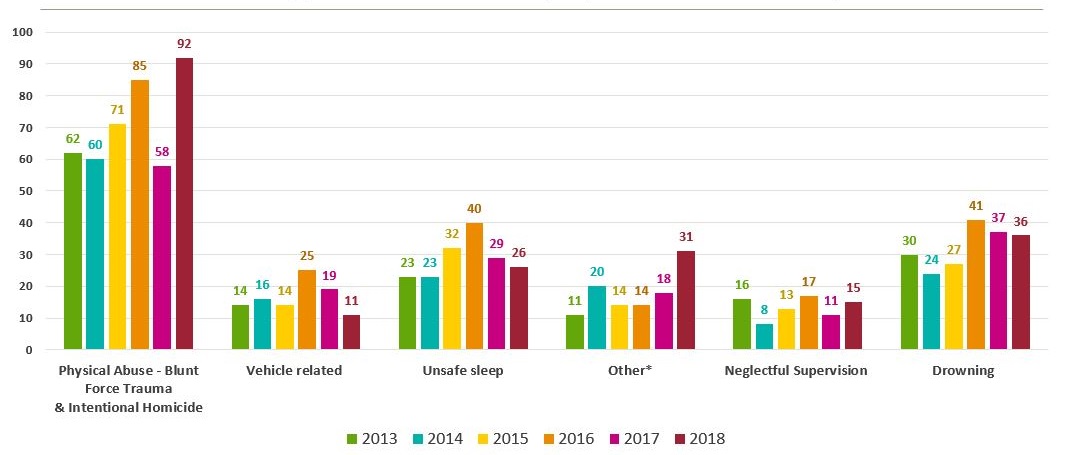
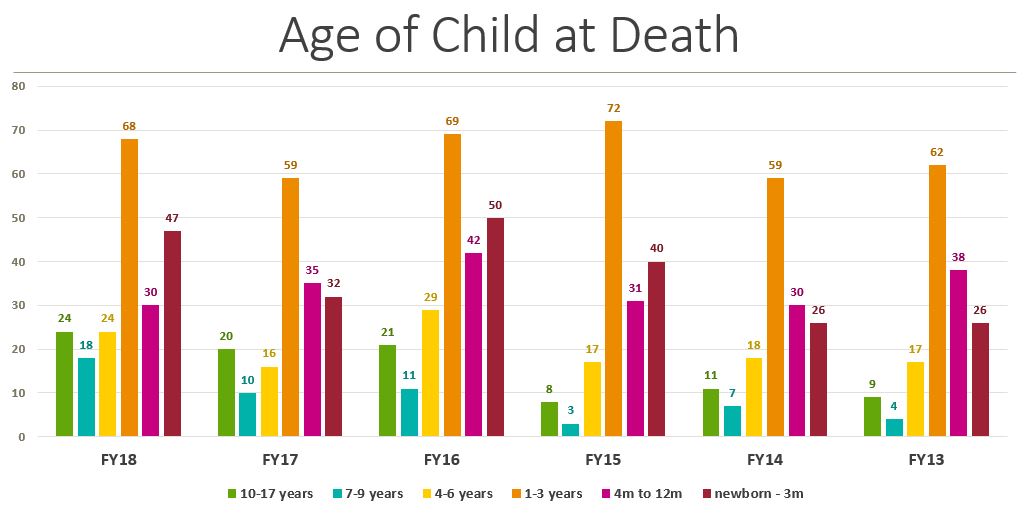
  • Texas had 211 confirmed child abuse and neglect-related fatalities in FY2018, an increase of 22.7% compared to FY2017 (172). 36% of the victims were infants and 69% were under the age of three.
  • The increase in child maltreatment fatalities in FY2018 is predominantly due to physical abuse fatalities which grew by 58% over FY2017.
  • In FY2018, Texas had 82 confirmed abuse and neglect-related near-fatalities, a decrease of 11.8% compared to FY2017.
  • The largest decrease was in non-fatal drownings, which dropped 33.3% compared to FY2017.
  • Vehicle-related deaths continue to decline and did so by 42% in FY2018. Examples of vehicle-related deaths include a child left in a hot car, a child unsupervised and struck by a vehicle, and a child riding in a car where the parent or caregiver driving was intoxicated or under the influence.
  • From FY2017 to FY2018 there was a 25% increase in child fatalities caused by abuse or neglect involving a parent or caregiver actively using a substance and/or under the influence of at least one substance that affected the ability to care for the child.
  • Abusive head trauma accounted for 45.1% of the total number of near-fatalities.

causes

Obviously, the increase in fatalities deeply troubles us, especially after the attention lawmakers paid to child maltreatment in the 2017 legislative session.

The 2017 session must not be viewed as an end point in the struggle against child maltreatment, but rather as a beginning. There are still profound challenges ahead in the ongoing 2019 session.

While the focus two years ago was heavily on Child Protective Services and foster care – the systems that pick up the pieces after tragedy has occurred – this session there needs to be an even greater emphasis on strengthening families before a crisis can happen.
age at death

The increase in fatalities are alarming and a call to action for greater emphasis on prevention and early intervention, especially at the youngest ages.

A combination of numbers that stands out to us:

  • Unlike fatalities that occurred the previous year, in 2018 the majority of fatalities due to abuse and/or neglect included families with no prior CPS history.
  • Additionally, the number of fatalities occurring from newborn to age 3 is on the rise, and so are the deaths caused by blunt force trauma – and those youngest ages are when children are most vulnerable to such violence, including abusive head trauma.

These are ages when new families can be under the most stress and have the least understanding of early childhood development – and the ages at which most home visiting (prevention) programs are targeted. If we can reach more of these families with home visiting and other parent education and tools, we can avert such tragic incidents.

To this end, these are TexProtects’ top priorities at the Capitol this spring:

  • Strengthening investments in community-based, primary child abuse prevention programs – specifically, a combined increase of $30.5 million toward Nurse-Family Partnership and the HOPES (Healthy Outcomes through Prevention and Early Support) Program to reach 3,600 additional eligible families
  • Developing a Texas plan to implement the provisions of the federal Family First Prevention Services Act, which would shift state investments toward services and resources that keep children out of foster care (Senate Bill 355)
  • Developing and implementing a statewide, strategic public health approach to address causes and symptoms of Adverse Childhood Experiences (House Bill 4183)
  • Implementing trauma-informed care training and policies in public schools (House Bill 3718)

TexProtects will continue to be at the Capitol, making the case for prevention to lawmakers every day, meeting them in their offices, providing them with research, and testifying in committees. Thank you for the support you’ve provided to our mission, including the emails you’ve sent to legislators this session. Check your inbox for future advocacy opportunities!

The State Budget: Building Upon Success

By Pamela McPeters
TexProtects Vice President of Public Affairs

The budget is one of the most significant responsibilities of the Texas Legislature. The Senate Finance and House Appropriations Committees of the 86th Legislature will soon be underway crafting the fiscal years 2020-2021 General Appropriations Act. As these committees work on competing interests, including school finance, Hurricane Harvey obligations and many others, it is imperative they prioritize the safety and well-being of Texas children. The child protective services system is experiencing increased pressure which requires investments to continue and build upon the progress made in the 85th Legislative Session. Pressure includes:

  • Abuse/neglect reports are projected to increase by 2.1% in FY 2020 over FY 2019 and 2.3% in FY 2021 over FY 2020.
  • Investigations are projected to increase by 2.5% in FY 2020 over FY 2019 and 2.6% in FY 2021 over FY 2020.
  • The number of confirmed findings of child abuse and neglect is projected to increase by 1.2% in FY 2020 over FY 2019 and 0.9% in FY 2021 over FY 2020.
  • Client Services Adoption Subsidies and Permanency Care Assistance caseloads are projected to grow 4.2% in FY 2020 and 8.6% in FY 2021 above FY 2019.
  • Day Care is projected to increase 7.1% children served in FY 2020 and a 13.5% in FY 2021 above the projected FY 2019 levels.
  • Purchased Client Services are projected to increase 5.0% in average monthly client caseloads in FY 2020 and 10.0% in FY 2021 above FY 2019.
  • Foster Care caseloads (FTEs) are projected to grow by 0.3% in FY 2020 and by 0.4% in FY 2021 relative to FY 2019 projected caseloads.

Below are some key priorities for funding:

#1 Expand Prevention Services (DFPS Exceptional Item 8)

Additional Details may be found on pages 534-536 of the Department of Family and Protective Services (DFPS) Legislative Appropriations Request (LAR)

$18.5 million to expand HOPES program into additional counties and increase families served from 4,660 families expected to be served in fiscal year 2019 to 7,060+ families served in fiscal years 20 and 21, an expansion of 26%.

Healthy Outcomes through Prevention and Early Support (HOPES) is a flexible, community-based approach to child abuse and neglect prevention in high-risk counties by increasing protective factors of families served. Currently serves families in 55 Texas counties with children ages 0-5 at risk for abuse and neglect. Families are commonly referred to HOPES by community organizations, clinics, school districts, or self-referral. Families generally participate in HOPES services for 3-12 months.

$12 million provide for a targeted expansion to increase the number of families served through Texas Nurse-Family Partnership from 2,725 families in fiscal year 2019 to 3,975+ families in fiscal years 2020 and 2021, a 20% increase.

Texas Nurse Family Partnership (TNFP) is a voluntary program in which registered nurses regularly visit the homes of low-income women pregnant with their first child. Families must start services with TNFP by their 28th week of pregnancy and can receive services until the child reaches two years of age. TNFP Serves expecting parents, new parents, and caregivers of children under the age of 2. Families are commonly referred by WIC, community clinics, school districts, and health plans. Families generally participate in TNFP services for two years.

#2 Maintain Client Services (DFPS Exceptional Item 2)

Additional Details may be found on pages 516-518 of the DFPS LAR

 $79.3 million for Day Care Services to address growth for fiscal years 2020 and 2021.

Day care services for children while biological parents are receiving services to preserve the family and/or when a child is placed with a relative, along with while a child is in foster care, increase safety. These services may provide for immediate or short-term safety from abuse and neglect; prevent the child from being removed from the home; allow the child to be reunited with the family; address the developmental needs of a child whose physical, social, emotional, cognitive, or language developmental delay is a significant factor in the risk of abuse or neglect in the home; and help stabilize the family.

 $52.3 million for Client Services for children and their families starting from intake, relative caregiver homes, foster and adoptive homes and post-adoption.

These services may include evaluation and treatment services, parent/caregiver training, and substance abuse assessments and treatment (individual, family and group counseling).

#3 CPS Initiatives and Operations (DFPS Exceptional Item 5)

Additional Details may be found on pages 525-530 of the DFPS LAR

$17.8 million to support CPS initiatives including, preparation for adult living skills assessment for older youth, determine eligibility, improve permanency and other frontline staff, case management for certain youth in extended foster care, services for children post-adoption and post-permanency, and medical services staff.

In addition, funding will support case management for youth with complex needs in extended foster care, behavioral health services to promote permanency, and support medical wellbeing.

 #4 Maintain Caseloads (Exceptional Item 1)

Additional Details may be found on pages 513-5515 of the DFPS LAR.

 $106 million to maintain average daily caseloads at manageable levels for CPS Investigations (13.9 cases), Conservatorship (23.1 cases), Foster/Adopt (17.3 cases), and Kinship (31.4 cases) and reduce statewide intake hold times by about half.

Here is a side-by-side comparison of key Child Protective Services line items from the House and Senate proposed budgets. After each chamber passes its respective version of the budget, they will then have to agree on a final version to send to Governor Greg Abbott.

House Bill 1 Senate Bill 1 Difference in SB1 from HB1 DFPS LAR Base Request DFPS Exceptional Item Request
2020-21 2020-21 2020-21 2020-21 2020-21
STATEWIDE INTAKE 45,903,260 45,903,260 0 45,903,260 16,868,045
A.1.1. Statewide Intake Services 45,903,260 45,903,260 0 45,903,260 16,868,045
CHILD PROTECTIVE SERVICES 3,702,740,868 3,698,484,378 (4,256,490) 3,629,796,180 323,927,022
B.1.1 CPS Direct Delivery Staff 1,478,091,278 1,536,903,280 58,812,002 1,517,333,763 143,204,700
B.1.2 CPS Program Support 89,541,930 90,159,264 617,334 90,508,294 12,444,948
B.1.3 TWC Contracted Day Care 197,539,038 197,539,038 0 140,245,446 84,278,580
B.1.4 Adoption Purchased Services 19,563,842 19,563,842 0 19,563,842 7,056,161
B.1.5 Post – Adoption/Post-Permanency 6,976,442 6,976,442 0 6,976,420 5,854,961
B.1.6 PAL Purchased Services 17,987,420 17,987,420 0 17,987,420 386,672
B.1.7 Substance Abuse Purchased Services 16,344,380 16,344,380 0 16,344,380 24,234,694
B.1.8 Other CPS Purchased Services 78,271,948 78,271,948 0 78,271,948 10,640,296
B.1.9 Foster Care Payments 779,127,440 1,041,748,299 262,620,859 1,049,176,063 29,108,240
B.1.10 Adoption/PCA Payments 612,413,881 612,413,881 0 615,753,103
B.1.11 Relative Caregiver Payments 80,576,584 80,576,584 0 77,635,479 6,717,770
B.1.12 Community-Based Care Payments 326,306,685
PREVENTION PROGRAMS 209,424,985 209,424,985 0 209,424,985 31,242,687
C.1.1 STAR Program 48,624,721 48,624,721 0 48,624,721 9,228,000
C.1.2 CYD Program 16,845,117 16,845,117 0 16,845,117 4,083,600
C.1.3 Child Abuse Prevention Grants 6,574,786 6,574,786 0 6,574,786 800,000
C.1.4 Other At-Risk Prevention 59,179,881 59,179,881 0 59,179,881 9,955,634
C.1.5 Home Visiting Programs 63,319,104 63,319,104 0 63,319,104 5,530,800
C.1.6 At-Risk Prevention Program 14,881,376 14,881,376 0 14,881,376 1,644,663

DFPS Submits Legislative Appropriations Request for 2019 Session

The 86th Legislative Session will begin January 8, 2019, and in preparation, the Department of Family and Protective Services released its Legislative Appropriations Request (LAR) for Fiscal Years 2020-2021 on August 31.

First, let’s review the previous session:

Before the 2017 Texas Legislative Session, Child Protective Services was plagued with problems. Governor Greg Abbott declared child protection an emergency, asking lawmakers to approve structural reforms and increase funding. The 85th Legislature responded by providing additional investments for Fiscal Years 2018-2019. Some of these investments were for: 1) prevention and early intervention, including home visiting programs, 2) additional caseworkers and meaningful salary increases to better ensure manageable workloads and retain caseworkers, 3) new relative caregiver monthly financial payments to reduce reliance on the foster care system and help keep children with their extended family, and 4) foster care payments for the legacy system and to expand Community Based Care to help stabilize the foster care provider base.

Due to the investments and legislation passed by the 85th legislature, DFPS has made significant advances:

  • Turnover in Investigations has dropped more than 14 percent, from 30.5 percent in July 2016 to 26.2 percent in July 2018. Similarly, investigative average daily caseloads have dropped more than 22.5 percent, from 16.4 in July 2016 to 12.7 in July 2018. Family-Based Safety Services (FBSS) and Conservatorship (CVS) have seen similar decreases and both are now below 20.0 percent.
  • More children are being seen by caseworkers in a timely manner with contacts for highest priority cases improving by almost 15 percent.
  • 36 percent more youth are completing the Preparation for Adult Living training, and the average number of months for foster children to permanency has decreased by 6 percent.
  • More children are being placed with relatives, an increase from 44 percent to 46 percent. The national average for relative placements is 32 percent.
  • Expansion of prevention services to increase the level of evidence-based programs and community initiatives to support children before they are abused and neglected. In the FY 2018-19 biennium, PEI projects to serve 128,000 families and youth, more than 98% of whom it expects to defer from both child protection and juvenile justice.

Now, the legislative appropriations request for 2019:

In its baseline request of $4.2 billion for fiscal years 2020-2021, DFPS requests funds to continue essential agency operations and a minor increase of 1.64 percent for Child Protective Services due to growth. The agency also includes exceptional items as an additional funding request to maintain current services levels, continue legislative initiatives, and fill in gaps in its service system and critical agency operations.

The Legislative Budget Board and the Governor’s Budget Office will hold a hearing for the public to weigh in on the agency’s LAR at 11am on Friday, Sept. 14, at the Texas Capitol, in room E2.016.

The additional funding requests include:

Prevention

  • $30.8 million to expand prevention services. Investment in prevention reduces the increasing demand for costly foster care by devoting resources to preventing maltreatment before a child is traumatized by abuse or neglect or separated from their family. PEI services also provide cost avoidance in juvenile justice and high Medicaid costs in adulthood. Some specific programs included in the request:
    • STAR – increased investment of $9,228,000 or 19% increase to expand its available programming across the state to serve an additional 6,000 families.
    • CYD increased investment of $4,083,600 or 24% increase to serve an additional 4,100 families.
    • HOPES – increased investment of $9,420,000 or 17% increase to serve an additional 1,200 families. HOPES could expand to serve contiguous counties of existing HOPES contracts. The Prevention and Early Intervention division of DFPS would also explore existing community need for increasing program capacity.
    • Nurse-Family Partnership – increased investment of $5,530,800 or 18% increase to serve an additional 550 families. Expansion of this program would blend geographic and programmatic expansion. While some programs may be poised to expand their geographic coverage to serve contiguous counties of existing TNFP contracts, other communities may increase the number of individuals they can serve.

Child Protective Services

  • $116.7 million for additional caseworkers, intake specialists, and support staff to maintain the caseworker and statewide intake workload levels and to lower the average hold time at the statewide abuse call center to 8.5 minutes.
  • $1.9 million for Employee Support Services to create a team to address the impact of trauma on direct delivery staff. As required by HB 1549, 85R, the proposed team will focus on development of a secondary trauma program and supports for caseworkers, including incident stress debriefing.
  • $4.4 million for a salary increase of $500/month for Statewide Intake staff to improve retention, thereby enhancing tenure and enabling improved performance.
  • $9.7 million to strengthen Child Protective Investigations outcomes, provide key investigations support, and prevent human trafficking.

Family Preservation

  • $136.6 million to meet the increased demand for day care, CPS client services, and relative caregiver financial assistance.

Foster Care

  • $62.6 million to support the continued phased in expansion of the Community Based Care foster care model to a total of nine geographic catchment areas covering approximately 74% of children in paid foster care by the end of fiscal year 2021. This request would continue and expand four existing catchment areas and fund five new catchment areas over the course of the biennium.

Child Healing

  • Funding for Medical Services Well-Being Staff to support CPS caseworkers and caregivers through initiating appeals, monitoring fair hearings, and facilitating resolution as part of the STAR Health processes associated with denials. Staff will also monitor data to analyze issues and coordinate with HHSC to resolve.

Preparation for Adulthood

  • $19.7 million for key initiatives and client support, including: Preparation for Adult Living staff and Regional Youth Specialists, additional case management for youth who have complex needs in Supervised Independent Living, and behavioral health services for children in post-adoption and post permanency relative homes.

Family First Prevention Services Act

The request for additional investment also includes a placeholder to address the new requirements from the federal Family First Prevention Services Act (FFPSA).

In February 2018, the United States Congress passed the FFPSA. The purpose of the bill is to provide investment further upstream to strengthen and preserve families and prevent children from entering the foster care system. The bill also better ensures children in foster care receive the most appropriate care for their individual needs in the least restrictive environment.

Implementation of FFPSA will help Texas attain its goals by 1) investing in results-proven programs and reducing child neglect and abuse fatalities; 2) promoting healthy biological families and supporting children with their relative families; 3) improving foster care to provide children with nurturing and safe foster families; and 4) ensuring children receive services to address their emotional, behavioral, and medical needs and heal their trauma.

Implementation of the Family First Prevention Services Act will have a significant positive effect on the lives of children and families in Texas.


Working Together to Build a Prenatal to Age Three Policy Vision for Texas

PN3 coalition logosThere’s a growing recognition across the country and in Texas that the experiences – positive or negative – during the first few years of childhood provide the foundation for a child’s life for decades to come.

Advocates, policymakers, philanthropists, and community leaders have worked to develop supports for families and children during this critical time, and there is now an opportunity to take those efforts to the next level in Texas.

TexProtects, Texans Care for Children, and Children at Risk are launching a new effort to collaborate with other Texas organizations and leaders in developing a focused Prenatal to Three (PN-3) Infant Toddler policy agenda.

The PN-3 policy and advocacy planning process offers an opportunity to engage early childhood stakeholders and statewide coalitions in a shared effort to determine how we can best raise awareness about the importance of children’s early years, identify a shared vision and goals for a PN-3 policy agenda, coordinate advocacy strategies for the 2019 Texas legislative session, and keep a focus on equity and inclusion in all advocacy and policy plans.

The goal of the planning process is to build support specifically for the following three early childhood initiatives:

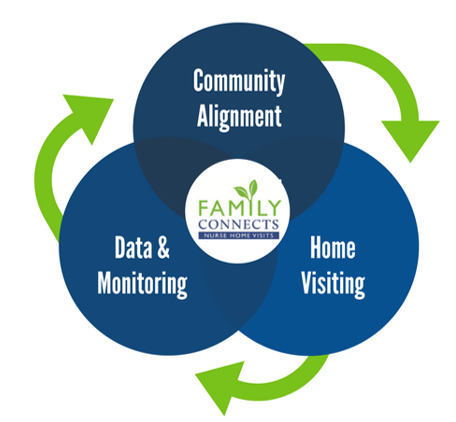
  • Expansion of a “universal connection” system in Texas (such as the Family Connects model) to assess, screen, and refer families to support services in the postpartum period or early childhood years
  • Increase access to high-quality home visiting programs for pregnant women and families with infants and toddlers; and
  • Increase access to affordable, high quality child care for infants and toddlers

This is the start of what we hope to become greater coordination and broad support for a prenatal to three shared policy vision. The kick-off meeting is on September 14.

This planning effort is supported by the Alliance for Early Success and funded by the Pritzker Children’s Initiative.

Home Visiting Works: Surviving Hurricane Harvey

One of the main purposes of the “Champions” blog is to highlight success stories from family support home visiting programs that illustrate how vital they are in building family resiliency. TexProtects advocated for the legislative funding that helped bring Nurse-Family Partnership to Texas, and has been a strong supporter of NFP ever since. This story first appeared on NFP’s website at www.nursefamilypartnership.org/stories/moms/

When Hurricane Harvey hit the Gulf Coast and greater Houston area, 28-year-old Mirna was among thousands of people forced to leave their homes for safer grounds. Though she graduated from Nurse-Family Partnership more than a year ago, she says her nurse Savannah reached out during the ordeal to offer support for her situation. “She is someone I can trust with things I don’t tell others, even if I don’t talk to her every day,” she says. “If I need any help I know I can ask her.”

Now parenting an active preschool aged daughter, Mirna was 19 weeks pregnant when she agreed to try the Nurse-Family Partnership program provided by Texas Children’s Health Plans in Houston, Texas. What convinced her to make that first appointment was the assurance that she could leave if she didn’t like it. The idea that a nurse would come to their “humble” home made her feel self-conscious. The first time her nurse, Savannah, came to see her, she realized her expressions were welcoming and not judgmental. After their first meeting, Mirna says, “some worries were put to rest.” Her partner Angel also brought questions to some of their meetings.

Her curious, active preschool aged daughter has thrived since they graduated from NFP. Mirna recalls that her nurse would bring her books and toys, always helping her learn to connect with her daughter. NFP nurses also help new mothers set personal goals to build a foundation for their new family. Mirna is a part-time student taking prerequisite courses for nursing school. She perseveres at both being a student and a mother. Every day they play, go to the park, and Mirna answers a lot of questions. Every answer, she says, “constantly are followed by three ‘why’s?’”In fact, Mirna felt her nurse was a perfect match for their family. “I am reserved and quiet, she never pushed to where I would feel uncomfortable.” Savannah provided her with “so much information to assure a healthy pregnancy and a healthy child,” she says. After her daughter was born, Mirna says she had even more questions, which Savannah answered honestly and kindly. “Any questions I had, regardless of how naive it sounded, she would answer with patience.”

“She asks a lot of questions, some are easy to answer, and some are harder,” Mirna says. “For example, how do babies come out from their mom?” Mirna delights in her daughter’s confidence, and the way she likes to introduce herself to new people.

Mirna felt like her nurse was more than a source of information. “She has been my rock,” she says. “Thanks to her guidance I was able to feel some hold on the entirely new, scary experience.”

TexProtects helping to bring a new home visiting program to Texas

At TexProtects, we are driven by a core belief: The best solution for child abuse and neglect is to prevent it from ever happening.

And the best method to support prevention is evidence-based family support home visiting programs. These are programs where a nurse, social worker, or similarly trained professional goes into the home – at the family’s invitation – to provide mentorship on parenting skills, maternal and child healthy development, and connection to mental health, substance use support and other community resources.

At TexProtects we believe that all families with newborns could benefit from at least a light-touch home visiting services. There are over half a million families with children under five in Texas and only 23,000 currently receive services. That’s why TexProtects is excited to announce that a new scalable program with proven success has come to the Lone Star State and it has demonstrated a 39% reduction in child abuse investigations per child through age five.

vennThe Family Connects model is a bit different than traditional home visiting programs.  After a child is born, a Family Connects nurse meets with all new mothers before discharge to assess for any health or family support needs.  The family is offered up to three follow-up visits in the home to ensure both mother and child are off to a healthy start. The Family Connects nurse connects families to resources such as child care, substance use or mental health services and concrete resources.
If the family’s needs require more intensive services, the Family Connects nurse refers families to programs that work with new parents over a longer period of time.

Family Connects comes to us via North Carolina, where it was founded in 2008 as Durham Connects, then funded and evaluated for 10 years by the Duke Endowment and Durham County Government. Here in Texas, it will be launched initially in two projects across four counties managed by United Way of Greater Austin and United Way of San Antonio: Travis, Bastrop, Bexar and Victoria. It is funded in part by the Department of Family and Protective Services’ Prevention and Early Intervention Division as well as philanthropic support from several community and family foundations. Family Connects is now a Maternal, Infant, and Early Childhood Home Visiting (MIECHV)-eligible program in Texas along with Nurse-Family Partnership, Parents As Teachers, and Home Instruction for Parents of Preschool Youngsters.

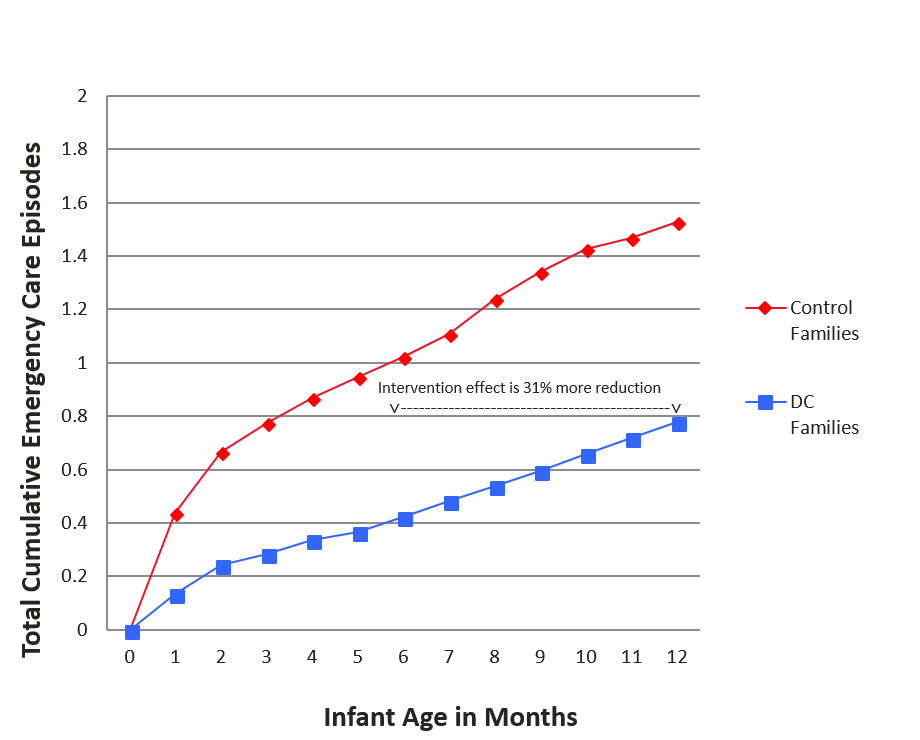
In addition to the 39% reduction in CPS investigations per child through age 60 months, the program also demonstrated many other positive results in comparison to a control group (those that do not receive the program) including:

  • 34% less total infant emergency room medical care sustained through infant age two
  • Higher quality child care for those that chose out-of-home care
  • More mother-reported positive parenting behaviors
  • Higher quality (blinded observer-rated) mother parenting behavior
  • Higher quality and safer (blinded observer-rated) home environments
  • 28% Less maternal reported clinical anxiety
  • 14% More connections to community services/resources

er graph

But the 39% reduction in CPS investigations is key. The top goal of the Family Connects model is to reduce the flow of families into the CPS system by making it unnecessary for CPS to ever get involved. In 2017 alone, Texas completed nearly 290,000 investigations of child abuse. If we could save 113,000 children from experiencing the pain and trauma associated with the child welfare system, at a cost of around $750 per family, why wouldn’t we?

And this money is recouped: Durham Connects has shown a return of investment of $3 for every $1 spent just in saved healthcare services alone, meaning it not only saves lives, but taxpayer dollars as well.

The program’s goal is to reach at least 60-70% of the births in each defined community with at least one home visit, with second and third visits provided to the families who need additional support or resources (typically 35% of families receive a second visit).

In the initial visit approximately three weeks post-partum, the family receives a two-hour visit that includes the following services by the nurse:

  • Newborn and mother health assessments
  • Education about newborn care, such as breastfeeding
  • An assessment of the family’s strengths and needs, including a look at 12 factors known to be linked to child maltreatment risk
  • Referrals to matched community agencies for each identified risk

If an assessment indicates a risk or need, nurses directly support families or connect them to community resources, typically through additional home visits and/or telephone contacts.

In cases of mild risk, nurses may provide direct support, such as breastfeeding assistance. If a family’s risk is more significant, the nurse collaborates with the family to connect them to desired community services and supports.

Supports may include referrals to more intensive, long-term home visiting programs such as Parents As Teachers or Healthy Families, mental health services, or primary health care providers. Nurses use a searchable database of local agencies, created by local program staff, in making referrals.

Finally, a follow-up phone call is made four weeks after case closure to further ensure connections to community resources are made.

With such a lot average cost per family to implement, this program is certainly scalable.

70% saturation of 400,000 annual births in Texas translates to an average investment of less than $650,000 per county per year.

Another important aspect to the program will be data collection, allowing communities to get a handle on what challenges are widespread and allowing needs to be aligned with available resources.

Home visiting programs are not one-size fits all, and each program currently operating in Texas is tailored to different stages of a child’s development and family needs. TexProtects is pleased to see Family Connects, with its proven track record, added to the mix here in Texas. TexProtects’ goal for home visiting in Texas is to reach at least 112,500 families with at least one home visiting program by 2025. With Family Connects added to the menu of services we are well on our way. With an estimated 48,000 births in the four implementing counties alone we likely will more than double the 23,000 families currently receiving services to nearly 50,000 over the next few years.

DPFS and the Austin and San Antonio communities have already paved the way by bringing this program to Texas, but TexProtects is eager to help scale this program through effective legislative advocacy and critical partnerships.

TexProtects, Texans Care for Children, and Children at Risk – with support from the Alliance for Early Success and the Pritzker Early Childhood Foundation – are partnering to develop a plan to bring this program to additional communities across Texas.

For more information on Family Connects, visit http://www.familyconnects.org/

For more information on the Durham project, visit www.durhamconnects.org.

View our PowerPoint presentation on Family Connects


Isabel: “My Child Wanted to Explore More and More”

Welcome to our new blog!

This first post is the beginning of a project by TexProtects to better communicate our mission to the public. We’ve named it “Champions,” in keeping with our mission to be “Champions for Safe Children.

TexProtects was created in 2004 with a mission to prevent child abuse and neglect, especially via family support home visiting programs, the only evidence-based method shown to prevent child maltreatment through strengthening family resiliency.

We will do this by telling home visiting success stories – spotlighting families that have been helped by inviting nurses, social workers and other support specialists into their homes for mentorship in parenting skills. Sometimes we’ll do it writing, other times with video, and whatever other engaging storytelling methods we can produce. Expect to see new stories every month or so, plus other news related to prevention and home visiting.

For more about home visiting, click here.

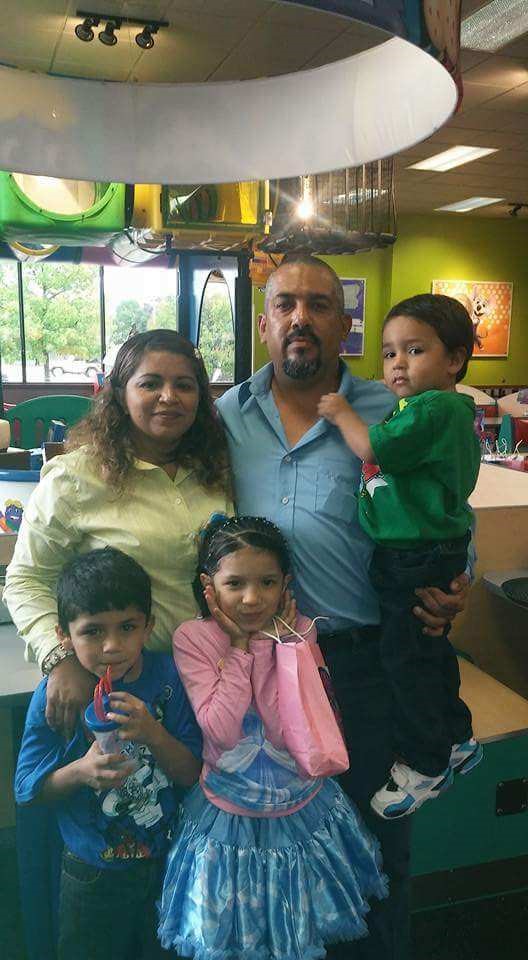
For this first installment, we present Isabel Garcia* and family, beneficiaries of the Born Learning Parent Engagement program by ChildCareGroup in Dallas.

*name changed to protect privacy

Isabel: “My Child Wanted to Explore More and More”

Isabel Garcia knew education is valuable. She knew it long before she had ever heard of home visiting.

What she wasn’t sure about was how to unlock the promise that education holds … how to spark her child’s mind and light the flame.

And then she discovered the Born Learning Parent Engagement Program, a home visiting program offered by ChildCareGroup. She enrolled in the program, which uses the Parents As Teachers curriculum, in 2013 out of love of her child, but quickly found out: Home visiting is about the whole family. Isabel was born to learn, as well.

“I liked it because the teacher involved the whole family: the child, the siblings, the father and myself,” Isabel says. “We all learned to read and enjoy cultural visits together as a family.

“When the teacher arrived to the house and I saw how she worked with us and how my child was learning, I was even more motivated. Then, the progress started. My child wanted to explore more and more. I liked it because the teacher worked hard and brought more activities when the child attained some milestone. More activities encouraged the child to learn even more.

“My child learned a lot during these past four years. Also, my family has grown culturally because we had the opportunity to enjoy museums. We used to think that it was more interesting going to the mall or the movies. We used to buy toys, sometimes too expensive, that did not teach anything as well. We learned to invest in educational toys and to create art. We saw in the museums that you can create by using recycled materials. We learned to spend more time together as a family and value everything nature gives us. Furthermore, we learned to create a healthy environment for our children.”

“[Isabel] is very involved in her children’s education and development,” says PAT Parent Educator Martha Hernandez. “I have encouraged her to be an active parent, volunteer in school and get to know the teachers. Isabel is volunteering often in the children’s school. Her children are doing very well in school because of their mother’s involvement and interaction.”

“Through the years, I discovered that the family education has helped us accomplish our goals, such as buying a house and saving for a new car,” says Isabel.

“I would like to say that we were very fortunate because the first teacher we had, Roseane, worked very hard for us. She was very dedicated to our family, beyond what was required of her as a teacher, and she is an excellent person. She always encouraged us to do better. She had all our trust.”

Fortunately for Isabel, PAT is more than a single teacher – it is a strong program that can deliver continuity of services.

“When we found out [PAT] was going to change the teacher, we already trusted the program, so we were confident we would have another great teacher,” says Isabel. “We were not disappointed because Ms. Hernandez has made us feel that this is more than just a program. She has gained our trust as well.

“Now our future vision is wider and we have more desire to learn and plan the academic future of our three children. I know her focus was the youngest child but she brought many community resources for the other children to continue their academic growth.

“My child is now 4 and half years and very independent, with great values and great academic skills as well as social and emotional stability,” concludes Isabel. “We have family goals and higher expectations. We are very grateful to the program because of the basic support it gave us. I only want to say ‘thank you’ for investing [in] my child, on his professional future so he can pay back the community with his values and skills. The same I can say about our family. Thank you very much. God bless you!”

Parents as Teachers promotes the optimal early development, learning and health of young children by supporting and engaging their parents and caregivers. PAT advances the delivery of high quality services for families through a comprehensive system of supports and innovative solutions. To learn more, visit parentsasteachers.org.

To learn more about TexProtects’ mission to promote and expand home visiting in Texas, visit www.texprotects.org/TXhomevisiting/.